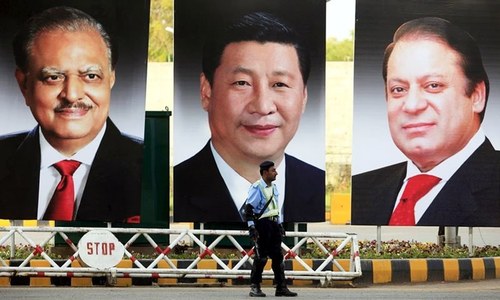
The government has released a summary of the Long Term Plan of CPEC, and although many of the details are not contained in the document, some disclosure is still better than none.
The thing to note in the document is the breadth and scope of the corridor enterprise, which, it is now clear, goes far beyond roads, power plants and transit trade.
The document provides pointers which say that Pakistan’s investment landscape is going to be reshaped to “encourage Chinese enterprises, private sectors and private sector funds of other economic entities to make various forms of direct investment”.
Aside from investment, the document points towards the creation of large tourist resorts along the Makran coast, implying a growing number of Chinese personnel living in Pakistan in the years to come, as well as elaborate financial interlinkages between China and Pakistan to facilitate investment flow and expand the role of the yuan in Pakistan’s external trade — for starters.
The sheer scope of what the document points towards is breathtaking, and even if a small portion of what is mentioned actually materialises, the project will indeed be a ‘game changer’ as the government repeatedly says.
Considering all this, it is imperative that the document be given a close read by all parties concerned, particularly in business and politics.
It is dismaying to the extreme that as an engagement of this magnitude gets under way, the entire national conversation is dominated by squabbling amongst politicians and the heads of various institutions. This is no way to begin a journey down a ‘game changer’ of a road.
It is also worth noting that the objections of Ahsan Iqbal, in his previous post as planning minister, to the Dawn story on the LTP published in May, stand nullified. The document released on Monday is only a summarised version of the same, more detailed document that the Dawn story was based on.
Given the magnitude of what is about to begin, the pressures that Pakistani rulers will face over the years until 2030 — the period that is covered by the plan — will be enormous, as the presence of Chinese capital and personnel increases.
For the benefits of the enterprise to truly be unlocked for Pakistan, political sobriety and stability will be essential. If our traditional slash-and-burn style of politics remains the norm in the years ahead, with political and institutional rivalry dominating the national discourse as well as the policy environment, it will put Pakistan at a catastrophic disadvantage throughout the process.
It is unclear how strongly Pakistan’s interests are represented on the CPEC negotiating table, but our current way of doing politics needs to end if we wish to extract maximum benefit from this enterprise for our country.
Published in Dawn, December 20th, 2017