At 50, the Pakistan Peoples Party (PPP) is not even a shadow of its past glory. Founded as a party of change and later evolving into a party of resistance, it is now a tragic spectacle of a dying legacy. Once the most powerful political force with its roots deeply entrenched in the masses, it has been reduced to a regional party, thus leaving a huge gap in national politics that is hard to fill.
The PPP has become more of a family business enterprise having little connection with the people that it once claimed to represent. Can the attempt to resuscitate the party under a third-generation Bhutto succeed? It seems doubtful that just the Bhutto name would help regain the political space that the PPP has lost.
It may be true that the PPP still espouses a more progressive ethos than most other mainstream national political parties. But the leadership seems completely alienated from the changing social, political and economic dynamics. It will need much more than dynastical appeal and shrine politics to lift the party up.
It is not just Bhutto family charisma but a new political programme and strategy that are needed to mobilise the new generation of Pakistanis looking for change. They will certainly not be impressed by mere slogans of ‘jiye Bhutto’. More important is what the party represents today and what kind of change it promises to bring.
Indeed, the party has some highly dedicated old guards still surviving in its ranks, but they seem completely out of place in the politics of wheeling and dealing that has been mastered by Asif Ali Zardari. Under his stewardship, the party has lost its traditional connection with the masses that, in the past, had helped the party survive some of the worst forms of state repression and bounce back after electoral setbacks.
Can the attempt to resuscitate the party under a third-generation Bhutto succeed?
Restoring the populist character of the party will indeed be the biggest challenge for the young Bilawal Bhutto Zardari who still has to go through the rigour that his illustrious mother had experienced. Living most of his life outside and now thrown into a leadership role without any real experience of the tricky game of politics or understanding of those who play it does not make it easy for the inheritor of the most formidable political legacy. It is also important to learn from the party’s history of struggle and the mistakes it has committed that caused its downfall.
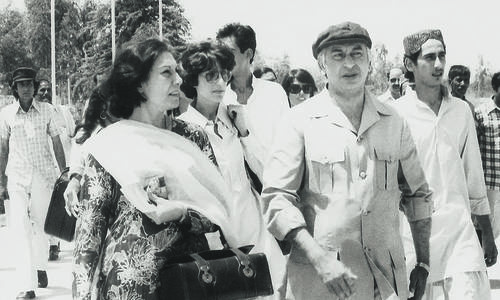
It was half a century ago when Zulfikar Ali Bhutto, undoubtedly the most charismatic politician this country has ever produced, founded the PPP that subsequently changed the Pakistani political landscape forever. With its socialist programme and populist slogans, the party instantly drew the support of the youth, the working class and the urban middle class across the country.
Having served as federal minister in Field Marshal Ayub Khan’s military government, Bhutto was not a novice in politics. His deep understanding of history and exposure to the outside world rendered him head and shoulders above other political leaders of the time. Bhutto formed the PPP after leaving the government following the disastrous 1965 war with India.
It is imperative to take cognisance of the domestic political dynamics and the international environment of the late 1960s in order to understand the PPP’s politics and its phenomenal rise as a popular political force. It was a period when popular movements for change swept across the globe and unrest against the military government in Pakistan had turned into a mass uprising.
Pakistan was ripe for change. Bhutto’s slogan of Islamic socialism and nationalism instantly struck a chord with students and the intelligentsia demanding restoration of democracy. Bhutto became a symbol of hope. His greatest contribution was that he gave a voice to the common people. Not surprisingly, the PPP emerged as the largest party in what was then West Pakistan in the first general elections in the country’s history.
But history would not judge Bhutto favourably for his role in the political crisis after the elections that ultimately led to the disintegration of the country. However, he certainly lifted the morale of a defeated nation. He rebuilt a truncated country and gave it a constitution. One of his greatest contributions was to diversify Pakistan’s foreign policy by shedding the traditional one-dimensional approach of dependence on the United States.
Bhutto’s authoritarian style of governance and his sweeping nationalisation of industries and financial institutions had, however, drawn intense criticism. Yet it did not affect his mass popularity. His ouster by a military coup and his judicial murder changed Pakistan’s political landscape forever. It has made him immortal in Pakistan’s political history.
While Benazir Bhutto took her father’s legacy forward, she also emerged as a leader in her own right, giving the party a new direction in the changing situation. Like her father, she had a strong grasp of history and her connection with her supporters was admirable. She suffered jail and hardship in exile more than any other political leader. She led the democratic struggle against the worst military dictatorship.
Although the people voted her twice into power, it was a constant struggle against the security establishment that tried to block her every step. Her first government lasted for only 18 months, while the second was cut short halfway through her term. Undoubtedly, her own inexperience and the allegations of widespread corruption charges involving her husband also contributed to the downfall of her governments.
There may be some criticism of her signing the National Reconciliation Ordinance with Gen Musharraf, but that move paved the way for elections and ultimately led to the restoration of democracy. She was the only leader who bravely challenged the militants and religiously inspired extremists who eventually caused her death.
Her party returned to power after her assassination. But the leadership gap left by her death has never been filled. The ascension to power of Asif Zardari brought a fundamental change to the party’s philosophy leading to its virtual downfall. It is certainly not an auspicious moment for the party to be celebrating its 50th anniversary.
The writer is an author and journalist.
Twitter: @hidhussain
Published in Dawn, December 6th, 2017