The ‘good old days’ of Karachi’s stock exchange


THE Karachi Stock Exchange (as the Pakistan Stock Exchange was formerly called) was established in 1947 coinciding with Pakistan’s independence. Along with the locals, the migrants from Bombay — where they traded in a flourishing stock business — were the first to seek membership of the newly established exchange.
Alibhai Nasir, a doddering veteran who still frequents the market, talks of “the good old days” when the members of the Parsi community and the upright Khoja jamaat dominated the list of members.
“Those were the days when a broker’s word was considered his bond,” he says. A broker who may have been ruined in a market crash would prefer to put a gun to his head and pull the trigger rather than collect the clients’ money and make good his escape to foreign shores, as happens so often these days.
A broker who may have been ruined in a market crash would prefer to put a gun to his head and pull the trigger rather than collect the clients’ money and make good his escape to foreign shores
Owing to limited communication channels such as telephones, Alibhai recalls that equity enthusiasts in the country were perforce “long-term investors”. It was impossible for them to “trade”, as the telephones in those days were rotary dial instead of push-button, so that by the time an investor in Lahore or Larkana managed to connect to his broker’s phone and place an order, the price of that stock had changed.
Thus the need for more exchanges was realised. The Lahore Stock Exchange was set up in 1970 and Islamabad Stock Exchange came into existence in 1992. Naturally, the local people of the province acquired the memberships of LSE and ISE.
Since much of the Parsi community started to migrate to India or the United States and Canada, Parsi brokers also started to diminish in numbers. Those who remained were aged and fragile. They gave up the principal positions on the board of directors of the KSE, maintaining a low profile. The void was quickly filled by the members of the city’s biggest class of businessmen, the Memons, who still outnumber all other community brokers combined.
But until the early nineties, when the government of Benazir Bhutto opened up the stock market to foreign investors, the local bourse was a sleepy place. There are lots of examples of people who sold a car, disposed of a small retail shop or retired from a job, strode to I.I. Chandigarh Road (then McLeod Road) and easily acquired the KSE membership card for a fair price.
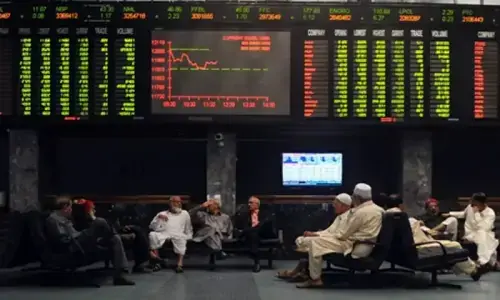
Almost all stockbrokers owned a single-room office, where at lunch the sandal-wearing, paan-chewing brokers would sit around to discuss joyfully the day’s trading, over a lunch of chicken karahi which an office boy would fetch from Bakra Hotel across the road — bakra, a Gujarati term for bench.
The stock exchange also used to enjoy the highest number of holidays in a year. Even the death of an elderly, bed-ridden past broker was reason enough to call a halt to trading for rest of the day’s session. “There was little jealousy, hardly any betrayals and fair competition among brokers at the time,” recalls another old-timer. The election to the bourses’ board of directors was a time to celebrate.
But all that changed with the entry of foreign investors and foreign funds in around 1992. Many stockbrokers for the first time saw the colour of the dollar. Paupers became millionaires and millionaires turned into billionaires in the wink of an eye. Worthless shares began to be sold to foreigners in incredible numbers at eye-popping premiums.
Some fair and others with foul means of misinformation, wrong research, front running and with connivance of foreign fund managers, started to trade in bulk. So huge were the trading scandals in those days that the Harshad Mehta scam of India’s Dalal Street would pale in significance.
Proprietor brokers started to turn to limited companies so as to attract big foreign brokerages. One-room brokerage houses started to vanish, and ravishing offices were constructed in the city’s landmark towers, all equipped with state-of-the-art network of computers, manpower, analysts, dealers and various sections, including money market and commodity desks besides equities.
The stock market became a place of big finance. Those who saw small-time brokers diversify into industries, and even set up banks, grudgingly called the exchange a “gambling den”. Limited to 200 memberships of the KSE at the time, those in possession of cards held on to theirs and further blocked the entry of new members.
A few brokers of the dominant community became “big brokers” as they started to accumulate membership cards from those who wished to sell. One big broker managed to buy out 10 or more cards and still wields considerable power in the working of the exchange.
Less-initiated brokers who could not cope with the speed became small fish in a pound infested with big sharks. But except for a couple of bold and challenging persons, no one could push into the bourse from other communities and acquire membership of the exchange.
Some who managed to enter became a target of intrigue and betrayal and were robbed of their last rupee.
An upcountry broker puts it this way: “First the members would join forces to keep away or ruin an outsider who might seek entry into the exchange. After having chopped him off, the community members would fight among themselves for bigger business.”
Published in Dawn, The Business and Finance Weekly, December 4th, 2017