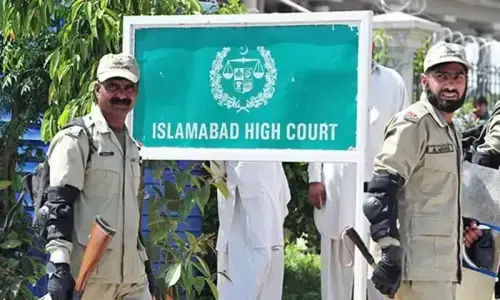
WHILE relief was the dominant sentiment when Khadim Rizvi and his supporters called off the Faizabad dharna earlier this week, the manner in which the TLYRA was placated by the authorities and the spate of dharnas that was triggered in major cities across the country got many worried. Words like ‘surrender’ and ‘capitulation’ have been prominent in op-eds and editorials, not to mention many social media platforms.
These expressions of alarm and frustration about the government’s unwillingness to stand up to the forces of the far right betray a much more disturbing truth about those who consider themselves ‘progressive’: whatever their self-perception, most ‘progressives’ simply don’t act consciously like members of a political community. And until and unless this changes, the ceding of ground to the far right will continue.
It has been 16 years and counting since the US invasion of Afghanistan triggered a polarisation of society that has buttressed the right wing and confirmed the marginality of those on the left. From the very beginning of the so-called war on terror, a substantial number of (armchair) progressives have vested their hopes in the state — initially American and then Pakistani — to magically cleanse society of religious militancy.
Progressives need to stand up and be counted.
It was believed that targeted military operations against any number of Salafi and Deobandi militant outfits would solve the problem. The recent dharna confirms that the ideology of militant Islam has actually spread well beyond its original carriers to the hitherto ‘peace-loving’ Barelvis.
In short, the state has failed spectacularly to douse the fires of religious radicalism. It is of course common knowledge that the state — more specifically the security establishment — has a highly selective policy when it comes to religiously inspired militants. Quite unbelievably, many ‘progressives’ both acknowledge the state’s continued protection of certain ‘strategic assets’ and then scream and shout about appeasement when the next patently obvious episode confirming the state’s selective policy plays out.
In my mind, it is simply not progressive to demand that the state — the very same state that has cultivated religious militancy — be the vanguard of the fight to reclaim society from the far right. A really progressive politics must be founded upon democratisation of the state – nothing less than a shift away from the ideology of ‘national security’ is required to address religious militancy and, as importantly, address ordinary people’s educational, health, recreational and other needs on the basis of a sustainable model of development that prefaces the multinational character of the polity. There is, quite simply, no shortcut to building a politics around this basic imperative.
No one is deluded about the PML-N — it is not a progressive political force, and it will never be one; some of its leadership may have stumbled upon certain progressive positions which has brought it into conflict with the establishment — eg, the desire to reduce tensions with India — but it is ultimately concerned with preserving its own power, not changing the power equation fundamentally in favour of the country’s long-suffering people, particularly outside Punjab.
Hence it will always harken back to its conservative roots, and not do anything more than flirt with a progressive policy orientation. In a nutshell, the PML-Ns of the world are always going to capitulate. Only a genuinely progressive political force would stand firm in the face of choreographed exercises like the recent dharna.
The absence of such a force in the political mainstream becomes ever more conspicuous with each such episode. Certainly the fact that such a left-of-centre political alternative is yet to emerge despite such serious contradictions within the structure of power suggests that there isn’t even a consensus about the content of a progressive political programme. For many lifestyle liberals, to be ‘progressive’ entails only railing about the mullahs and making no commitment to redressing class privilege and other deeply entrenched social cleavages.
Nevertheless there are enough genuine progressives out there who recognise the complexity of Pakistani state and society for a popular movement on the left to crystallise. The problem is that this critical mass doesn’t call itself by a collective name that most progressives still think of themselves as forward-thinking individuals rather than a part of a common front. Sometimes these individuals do come together — to mobilise around ethnic-national oppression, or patriarchy — but this still doesn’t add up to a countrywide left-wing political movement.
That is where the right-wing distinguishes itself — it is a growing, organised force and claims to speak for society at large. Yes it has benefited from decades of state patronage, but that cannot be our excuse. The state has not surrendered — it is doing what it has done for decades. Progressives need to stand up and be counted, or accept that theirs is the real surrender.
The writer teaches at Quaid-i-Azam University, Islamabad.
Published in Dawn, December 1st, 2017