Nearly 60 people were killed when suicide bombers detonated explosives in two separate mosque attacks in Afghanistan on Friday, officials said, capping a bloody week in the war-torn country.
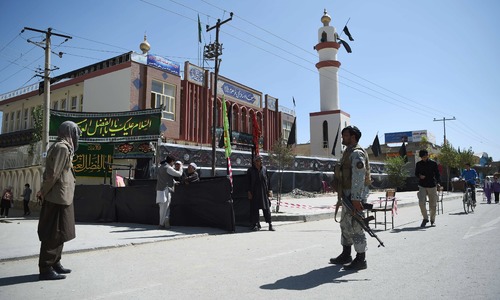
A gunman opened fire on worshippers in a Shia mosque in Kabul before he blew himself up on Friday evening, police said, in the latest attack to hit the Afghan capital.
An Afghan official at the interior ministry said the Kabul bombing killed at least 30 people and wounded 45.
Hours later, at least 10 people were killed in a second attack when a suicide bomber blew himself up in a Sunni mosque in central Ghor province, officials said.
Ghor attack
A senior local police commander, who is believed to have been the target of the attack on a Sunni mosque in the Dolaina district of Ghor province, is among the dead, district governor Mohsen Danishyar told AFP.
Danishyar put the death toll of the Ghor attack as high as 30, but Ghor provincial governor Naser Khazeh told AFP that he could only confirm 10 deaths.
Two attacks in southeast Afghanistan killed 80 people and wounded nearly 300 on Tuesday, one of the bloodiest day in the war-torn country in almost five months.
On Thursday, 43 Afghan soldiers were killed in another suicide attack on a military base in Kandahar. All three attacks targeted security officials and were claimed by the Taliban.
Kabul bombing
“A suicide bomber entered the mosque in Police District 13 of Kabul city. The attacker opened fire on worshippers,” Kabul Crime Branch chief Gen Mohammad Salim Almas told AFP.
Maj Gen Alimast Momand said the attacker was on foot and walked into the mosque in the city's Dashti Barch area.
“Unfortunately this evening a suicide bomber detonated himself among the worshippers inside a mosque in Dasht-e-Barchi neighbourhood of Kabul city,” Kabul police spokesman Abdul Basir Mujahid told AFP.
Interior ministry spokesman Najib Danish confirmed the attack toll on Twitter.
“I was in the mosque bathroom when I heard a blast. I rushed inside the mosque and saw all the worshippers covered in blood,” Hussain Ali told AFP. “Some of the wounded were fleeing. I tried to stop someone to help me help the wounded but everyone was in a panic. It took ambulances and the police about an hour to reach the area.”
No group has claimed responsibility so far. However, recent assaults on Shia mosques have been carried out by the militant Islamic State (IS) group.
The last attack on a Shia mosque in Kabul happened on September 29 as Muslims prepared to commemorate Ashura, one of the holiest days in the Islamic calendar.
Six people were killed when a suicide bomber posing as a shepherd blew him up near Hussainia mosque, one of the biggest Shia centres in the city, as worshippers gathered for Friday prayers.
Social media users launched an online campaign calling on people to donate blood for the wounded being treated at two hospitals.