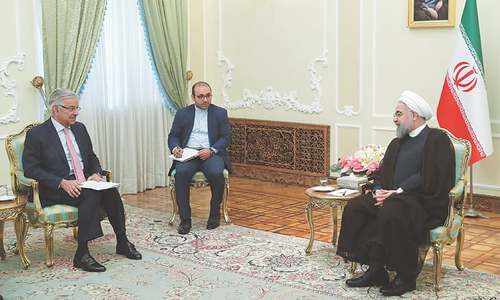
Prime Minister Shahid Khaqan Abbasi and Iranian President Muhammad Hassan Rouhani on Wednesday agreed to "maintain a trajectory of positive progress" between the two countries and the resolution of conflict in Afghanistan.
The two leaders had met on the sidelines of the 72nd session of the United Nations General Assembly in New York.
They agreed that there was no military solution to the Afghan conflict and a politically-negotiated settlement was vital for lasting peace in Afghanistan.
Underscoring that Afghanistan's neighbouring countries were seriously affected by the growing instability in the war-stricken country, the two leaders emphasised the need to adopt a regional approach to bringing an end to the prolonged Afghan conflict.
According to Iran’s Islamic Republic News Agency (IRNA), Rouhani also said that Iran attaches great importance to the expansion of relations with Pakistan.
In return, PM Abbasi assured the Iran president that Pakistan has a strong commitment — rooted in common history, culture and people to people ties — towards strengthening relations with Iran.
President Rouhani was said to have emphasised that the two countries should work together closely in deepening mutual cooperation in the areas of border management, trade and investment.
Touching upon the potential for expanding mutual cooperation, Rouhani voiced the Iranian side's readiness to supply energy to Pakistan, adding that Tehran had fulfilled its commitments regarding the gas project and was willing to complete the venture, IRNA reported.
According to IRNA, the Iranian president also invited Pakistani businessmen to invest in the neighbouring country.
According to IRNA, while commenting on the security condition of the Pak-Iran common border area, President Rouhani urged Pakistani officials to identify culprits of attacks on Iran that were carried out from Pakistani soil.
The prime minister later thanked Rouhani for the country’s consistent support to the legitimate struggle of the people of India-held Kashmir towards their right to self-determination.
The prime minister and the Iranian president also expressed deep concern over the atrocities being committed against Rohingya Muslims in Myanmar and urged the international community to take urgent measures to alleviate the suffering of the persecuted people.