Famed US spacecraft burns up in skies over Saturn


 18
18
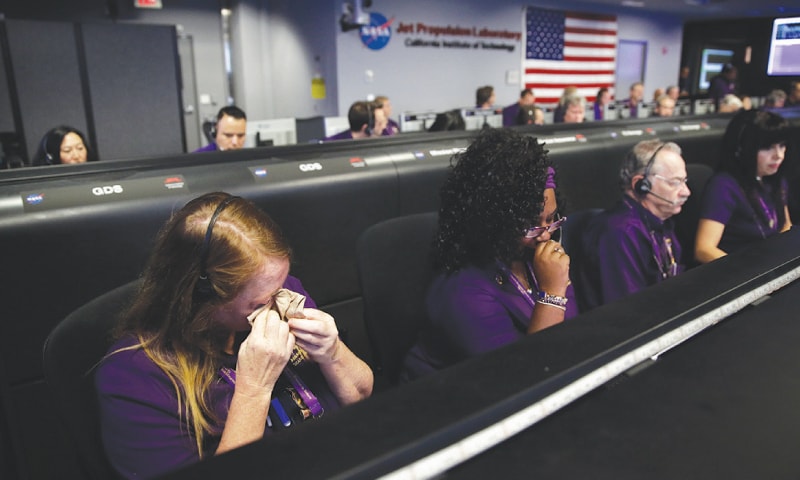

CAPE CANAVERAL: Nasa’s famed Cassini spacecraft disintegrated in the skies above Saturn early on Friday in a final, fateful blaze of cosmic glory, following a remarkable journey of 20 years.
Confirmation of Cassini’s demise came at about 7.55am EDT. That’s when radio signals from the spacecraft to Earth came to an abrupt halt. The radio waves went flat, and the spacecraft fell silent.
Cassini actually burned up like a meteor 83 minutes earlier as it dove through Saturn’s atmosphere, becoming one with the giant gas planet it set out in 1997 to explore. But it took that long for the news to reach Earth a billion miles away.
The only spacecraft to ever orbit Saturn, Cassini showed us the planet, its rings and moons up close in all their splendour. Perhaps most tantalising, ocean worlds were unveiled on the moons Enceladus and Titan, which could possibly harbour life.
Dutiful to the end, the Cassini snapped its “last memento photos” on Thursday and sampled Saturn’s atmosphere on Friday morning as it made its final plunge.
Programme manager Earl Maize made the official pronouncement: “This has been an incredible mission, an incredible spacecraft and you’re all an incredible team,” Maize said. “I’m going to call this the end of the mission.” Flight controllers wearing matching purple shirts stood and embraced and shook hands.
More than 1,500 people, many of them past and present team members, had gathered at California’s Jet Propulsion Laboratory for what was described as both a vigil and celebration. Even more people congregated at nearby California Institute of Technology, which runs the lab for Nasa.
The only spacecraft to orbit the planet, Cassini showed its rings and moons in all their glory
Nasa’s science mission director, Thomas Zurbuchen, took notice of all the tissue papers inside JPL’s Mission Control, along with the customary lucky peanuts. Team members were clearly emotional, he said.
“These worlds that they found, we never knew were there, are changing how we think about life itself,” he said. “And so for me, that’s why it’s truly a civilisation-scale mission, one that will stand out among other missions, anywhere.”
Project scientist Linda Spilker noted Cassini had been running “a marathon of scientific discovery” for 13 years at Saturn. “So we’re here today to cheer as Cassini finishes that race,” she said.
The spacecraft tumbled out of control while plummeting at more than 122,000 kilometres per hour. Project officials invited ground telescopes to look for Cassini’s last-gasp flash, but weren’t hopeful it would be spotted against the vast backdrop of the solar system’s second biggest planet.
This ‘grand finale’, as Nasa called it, came about as Cassini’s fuel tank started getting low after 13 years exploring the planet. Scientists wanted to prevent Cassini from crashing into Enceladus or Titan and contaminating those pristine worlds. And so in April, Cassini was directed into the previously unexplored gap between Saturn’s cloud tops and the rings.
Twenty-two times, Cassini entered the gap and came out again. The last time was last week.
Published in Dawn, September 16th, 2017