Is there a solution to the Rohingya crisis?


Authorities in Myanmar say close to 100 people have been killed since Aug 25 when armed men, reportedly from the Arakan Rohingya Salvation Army (ARSA), launched a pre-dawn raid on police outposts in the conflict-torn region; and this has been blamed as the main cause of the latest violence in Arakan.
According to one report, “The army has declared a war against ‘terrorism’, encircling the townships of Maungdaw, Buthidaung and Rathedaung, home to around 800,000 people, and imposed a curfew from dusk to dawn” perhaps to further tighten its control on the most persecuted community in the world.
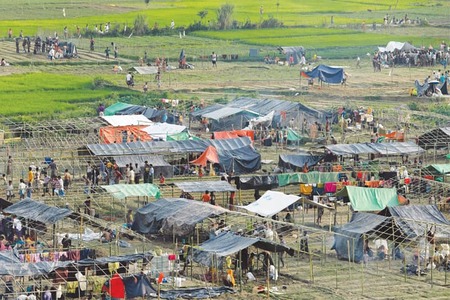
Rights groups have reported that close to 800 men, women and children have been killed, and the latest violence has also triggered another refugee surge across the border towards Bangladesh.
Rohingyas blame the Myanmar government and the army for the situation, saying soldiers are shooting indiscriminately at unarmed men, women and children and carrying out arson attacks. The Myanmar authorities, however, blame ARSA “extremist terrorists” for the killings and the fires.
However, given Myanmar’s past record, it is not hard to assume the truth.
The fact that Myanmar would not allow any neutral monitors on the ground confirms the claims made by the Rohingyas as well as the rights groups. Furthermore, Myanmar leader and Nobel Peace Prize winner Aung San Suu Kyi’s opposition to the claims and refusal to meet any journalist that asks questions about the Rohingya situation is an indication of her government’s discomfort with the truth.
Until now, the government has been pretty consistent in its treatment of the Rohingyas — persistent persecution, insistent denial and systematic refusal to permit neutral probe.
It appears as if Myanmar’s ultimate aim is to kill and frighten the Rohingyas so that they depopulate themselves from the region on their own accord.
With the inaction and apathy of the international community, this looks more and more like a looming possibility, although the UN has agreed that it believes Myanmar army’s response amounts to “ethnic cleansing”.
The emergence of ARSA has added a new dimension to this situation. We don’t know much about it. Is this something that has emerged out of desperation from within or is this something that has been engineered by the authorities?
ARSA’s spokesman, however, claims that it is a force from within created to “defend, salvage and protect Rohingya community in Arakan with our best capacities as we have the legitimate right under international law to defend ourselves in line with the principle of self-defence.”
While ARSA may have a motivation to fight for the cause of Rohingya salvation, they have to be careful about how they pursue their goals.
On the other hand, as is conceivable, Myanmar government’s response to their actions would be harsh and intensify miseries of the very people that they are trying to “defend”.
Furthermore, and this is something that ARSA needs to consider carefully, that their actions may now provide perfect raison d’etre to Myanmar government to justify, indeed morally, its violence.
As Rohingyas are Muslims, in the current international political climate of Islamophobia, it would be only too easy to paint ARSA and, by extension, the wider Rohingya population as “Islamic terrorists”, and thus turn the victims into villains and the real villains into the virtuous. Rohingyas will be like the Palestinians, demonised and persecuted with impunity and with twisted morality.
In the recent melee, the real loser — morally, that is — seems to be Bangladesh. Unlike Thailand, which has opened its border to Rohingya refugees, Bangladesh has proposed joint military operations with Myanmar army against the Rohingya fighters.
Sadly, instead of trying to find a permanent solution for the Rohingyas, Bangladesh is opting to do the most despicable thing, joining the persecutors in their killing mission.
Myanmar has tried violence as remedy for the Rohingya issue for the last several decades with no effect, and more violence is unlikely to give them anything better.
However, Myanmar’s addiction to violence drives home an important message: solution will not come in this way. It has to come from outside.
The international community has to play a much stronger role otherwise, as someone has argued recently, “like other stateless and unrepresented Muslims, [the Rohingyas] are at risk of producing a persistent terrorist threat” that in the end would not only destabilise Myanmar but also its neighbours.
Myanmar government’s consistent refusal to do something more conciliatory and dignified about the issue and the fact that it even denies any wrongdoing, suggest that conventional diplomacy will not work.
Something out of the ordinary is called for, and given the trust deficits on both sides, it may be worthwhile for the UN to step in and devise a solution based on its experiences of similar situations in other parts of the world.
The Daily Star / Bangladesh
Published in Dawn, September 6th, 2017