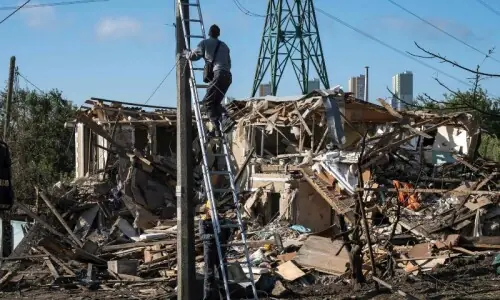
MUMBAI: As Mumbai mops up after its worst floods in more than a decade, experts say India must police urban sprawl more tightly to protect its packed cities from ever more frequent, fatal floods.
Urban planning needs to radically improve, they say, to ensure land is used safely as developers rush to cash in on India’s rural poor moving to cities in ever greater numbers.
If not, people will continue to die in the sort of heavy monsoon rains that killed more than a dozen in Mumbai this week, destroying homes, felling buildings and spreading chaos.
“The frequency and intensity of extreme weather events is rising, yet we plan infrastructure only after building over everything,” environmentalist Debi Goenka told the Thomson Reuters Foundation.
As Mumbai struggled to cope, similar flooding hit the cities of Bengaluru, Ahmedabad and Chandigarh, while nearly 300 were killed in floods in the southern city of Chennai in 2015.
With increasing urbanisation and more extreme weather events forecast — including variable rainfall — analysts urged India to impose strict checks on urban land use.
“Nearly all our cities are at risk of floods because of unchecked urbanisation and depletion of water bodies,” said Sushmita Sengupta at the Centre for Science and Environment, a New Delhi-based think tank.
“The wetlands, which are meant to be sponges for water, are built over, storm-water drains are clogged with garbage, so there is no system for rainwater run-off; where will the water go?”
By 2050, half of all Indians will live in urban areas.
While city officials say no amount of planning can adequately deal with the sort of heavy rainfall seen this month, analysts say the urban model is flawed, with commercial interests taking precedence over environmental concerns.
Mangroves destroyed
In Mumbai, which has amongst the priciest real estate in the world, mangroves and wetlands have been destroyed to build office towers, which also block the mouth of the River Mithi.
The deluge this week, after the city received nearly a month’s worth of rainfall in a single day, revived memories of the floods in 2005 that killed more than 500 people.
Most victims lived in slums, home to more than half the city’s 20 million population.
“During the 2005 floods, city officials said it was a once-in-100-years event. Today they’re realising it’s a once-in-10-years event,” said Goenka, the environmentalist.
About 65 million people live in India’s slums.
Improving their infrastructure — with storm-water drains, sanitation facilities and embankments — is essential to disaster preparedness, analysts say.
Yet a $7.5-billion Smart Cities Mission that aims to modernise 100 Indian cities with high-speed internet and efficient public transport may evict slum dwellers and lead to yet more concrete structures.
“We cannot prevent future flooding disasters unless city officials commit to curbing the real estate industry and to not doing further damage to the wetlands,” said Nityanand Jayaraman, an environmental activist in Chennai.
“If that means going without an additional flyover, so be it; if that means de-congesting our cities, we have to do it. There are no short cuts,” he said. —Reuters
Published in Dawn, September 1st, 2017