India's independence day observed as 'black day' in Kashmir

India's Independence Day was observed as "black day" in Azad Jammu and Kashmir (AJK) on Tuesday where public meetings and protest rallies were held in almost all cities and towns.
The main event of the day was a public rally held in Muzaffarabad led by the Prime Minister Raja Farooq Haider Khan and joined by members of AJK's legislative assembly, leaders of different political parties and others.
The participants of the rally handed over a memorandum to United Nations Observer to Secretary General in Muzaffarabad, demanding implementation of its resolution regarding Kashmir passed in 1948.
The memo also demanded that the UN Secretary General take serious note of gross human rights violations and atrocities by Indian forces in the valley and send a special fact finding mission in the valley to assess the situation.
Earlier, Prime Minister Raja Farooq Haider Khan, while addressing the rally, said that the Indian government was trying to revoke the special status of Jammu and Kashmir from its constitution which was against international laws and UN resolutions.
He said such attempts would be foiled by Kashmiri leadership and vowed to convince foreign affairs ministry to take up the issue in UN's Security Council.
"Kashmiri people have made sacrifices for their right to self-determination and would never bow before Indian military's atrocities," Haider said.

Curfew in India-held Kashmir
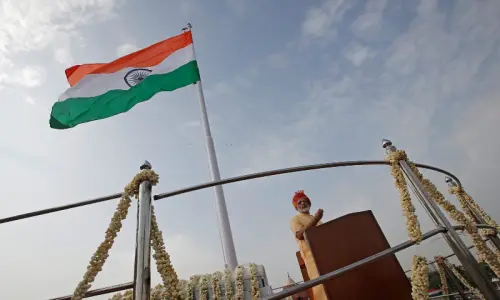
Meanwhile, curfew and other restrictions were imposed across India-held Kashmir, particularly in Srinagar, where the main function of India's Independence Day was to be held.
Bakshi Stadium, the main venue for the day celebrations, was sealed prior to the beginning of celebrations, Kashmir Media Service reported.
Indian Army and paramilitary personnel were deployed after every two kilometres on Srinagar-Jammu highway stretch from Sonwar to Bijbehera. Similar arrangements are in place on Srinagar-Baramulla highway stretch.
Meanwhile, the joint resistance leadership comprising Syed Ali Gilani, Mirwaiz Umar Farooq and Muhammad Yasin Malik in a statement condemned imposition of curfew in Srinagar and other areas.
"The curfew-like restrictions, bans, blockades and curbs are the standard response by India and its stooges to peaceful protests," the leaders said.