0
0
KARACHI: The Sindh High Court on Friday directed the Sindh and federal governments to respond to the constitutional petitions filed by two opposition parties against a new provincial law that repeals the applicability of the National Accountability Ordinance (NAO) 1999, better known as NAB Ordinance, in the province.
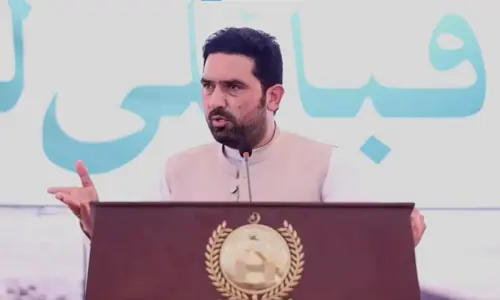
The petitions against the repeal of the NAB Ordinance were separately filed by Dr Farooq Sattar of the Muttahida Qaumi Movement-Pakistan and Nusrat Sehar Abbasi of the Pakistan Muslim League-Functional.
A two-judge bench of the high court also issued notices to the federal and provincial law officers and put off the hearing to Aug 16.
The provincial assembly had on July 3 passed the National Accountability Ordinance 1999 Sindh Repeal Bill, 2017 that repealed the applicability of the NAB Ordinance to departments and autonomous bodies controlled by the provincial government. It had also approved the establishment of a provincial accountability agency that would replace the decades-old Anti-Corruption Establishment.
According to the petitioners, the National Accountability Ordinance 1999 Sindh Repeal Act, 2017 is an attempt by the PPP to protect its corruption and is against the basic scheme of the Constitution.
Sindh Governor Mohammad Zubair had refused to sign the bill and sent it back with objections after it was first approved by the provincial assembly on July 3.
Later on July 27, the provincial assembly passed a new draft bill after the Sindh cabinet discussed the observations of the governor.
However, the governor did not give his assent the second time either.
Under the new law, the Sindh government would establish accountability courts in the province and such courts would be headed by a district and sessions judge (DJ), or a person qualified to be appointed as DJ.
There would also be an accountability commission comprising chairman of the agency, advocate general of the province, prosecutor general, director general and director-investigation of the agency. The commission would review the progress of cases of corruption and recommend to the government steps for the eradication of corruption in Sindh.
Meanwhile, in a letter to respective provincial departments, commissioners and deputy commissioners on Friday the Sindh government stated that with the revocation of the NAO, all corruption cases, inquiries and complaints would now be probed by the provincial anti-corruption establishment.
The letter reiterated that with the new law in effect, NAB would have no role in the province, as it was now mandated to only probe and hear cases related to federal institutions.
Published in Dawn, August 12th, 2017