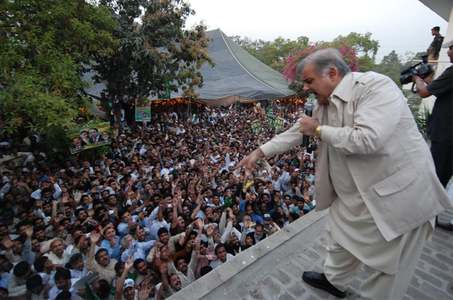
It is certainly not Nawaz Sharif's first protest march from the seat of power to his powerbase.
The last march in 1993 was in fact a whistle-stop tour from the Rawalpindi train station to the one in Lahore after General Abdul Waheed Kakar and President Ghulam Ishaq Khan conspired to oust an elected prime minister. Mr. Sharif led the protest from a train.
I rode the train with Mr. Sharif along with other journalists. I remember his light-coloured shalwar kameez, his dark-coloured socks, and that gloomy look stretched over his face, which has always failed to hide his emotions.
Mr. Sharif, I believe, would make a terrible poker player.
At every major train station along the route, Mr. Sharif addressed his supporters who had turned up in large numbers. He was robbed of a political mandate that he believed he had earned fair and square. But it was no secret that his party was partly to blame for denying the late prime minister Benazir Bhutto the opportunity to complete her tenure.
Politics back then was more about pushing, shoving, and conspiring with dubious state agencies who felt entitled to flout the constitution and due process. Mr. Sharif was part of the system that engineered the socio-economic chaos, but he hoped that he would be spared.
He was, though, not spared the first time around, or the second, or the third.
Mr. Sharif’s march (homecoming rally) today from the political gallows (soo-e-daar) in Islamabad to the friendly streets (koo-e-yaar) in Lahore will allow him yet another opportunity to reach out to his powerbase. I hope that Mr. Sharif takes the opportunity to reflect on what he could have done differently to avoid this fate.
Mr. Sharif is likely to remind his supporters of his government’s accomplishments of which there are many. Under his successive tenures, the road network in Punjab has improved tremendously. His government has been able to reduce – although not end, as promised – the chronic power outages that his predecessors failed miserably to address. Large swaths of territory in the tribal areas has been recaptured from the Taliban and their allies.
And then there is the China Pakistan Economic Corridor (CPEC) that has brought Chinese funds, expertise, and human capital to Pakistan to create a trade route that runs from Gawadar to China while passing through the poorest parts of Pakistan. The transshipment economy enabled by the CPEC corridor has the potential to transform economic productivity across Pakistan.
If Mr. Sharif were to make a final governance transformation where institutions take precedence over family, he may never have the need to run a protest march from koo-e-daar to soo-e-yaar.
Last month, I visited Pakistan to collaborate on road sector and urban development projects. My hotel in Lahore was full of guests from China. Until recently, hotels in Pakistan seldom saw any foreign guests.
After the West turned its back on Pakistan in 2011, foreigners almost stopped visiting Pakistan. Many countries put Pakistan on a travel advisory. Flights to Pakistan used to carry several foreigners who could be seen later touring the walled cities or holding meeting at fine hotels. Lately, only Pakistani expats could be seen flying to and from Pakistan.
CPEC indeed has changed the outlook in and on Pakistan. From Islamabad to Gwadar, hotels and rest houses are full of Chinese engineers, planners, financiers, and government functionaries. Senior civil servants in Pakistan are also aware of the tremendous opportunities that lie ahead for the nation. My meetings last month with government functionaries in Punjab started as early as 8 in the morning and lasted as late as midnight.
I experienced firsthand the sate functioning and trying to deliver with the meagre resources at its disposal. Mian Nawaz Sharif is justified in reminding the country of these achievements.
There is, however, the need to reflect on the past experiences and see how Mr. Sharif could have done things differently. For instance, he might reflect on why his march is along the jurnaili sarak (the title of Raza Ali Abidi’s book about the GT Road) that was delineated centuries ago and not along the Motorway built during Mr. Sharif’s tenures.
The Motorway bypasses cities between Islamabad and Lahore while the GT Road passes through them. To reach out to the masses, one must pass through the cities, and not bypass them.
Mr. Sharif’s last three tenures exemplify bypasses. His lack of attendance in, and the attempts to bypass, the parliament, his lack of trust in those not related by blood to him, his disregard for establishing his political party as an institution and preference for running it as a family business where a Sharif succeeds another Sharif, his inability to delegate executive authority have contributed to cutting his tenure short. With a failing healthcare and education system, many question why the successive Sharif tenures focused primarily on intercity roads and token urban transit projects.
Given that Mr. Sharif’s party maintains a strong hold on Punjab, which is more than 50 percent of the electorate, and that the opposition parties cancel out each other’s vote banks in smaller provinces, it is quite likely that Mr. Sharif may get another chance to lead Pakistan.
If Mr. Sharif were to make a final governance transformation where institutions take precedence over family, he may never have the need to run a protest march from koo-e-daar to soo-e-yaar.
Have you ever or do you regularly participate in rallies? How important do you consider them in fighting for a cause? Write to us at blog@dawn.com