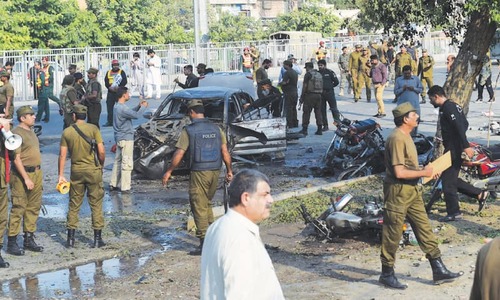
Yet another major terrorist attack in Lahore with a significant death toll and injury count has underlined the drift in national counterterrorism efforts.
In the immediate aftermath of the attack, despite the banned TTP claiming responsibility, it is difficult to establish a link between a bombing in urban Pakistan and an aggressive military operation in Fata. Yet, the past suggests that military operations in Fata tend to raise the threat in other parts of the country as the militants seek revenge. So were intelligence-gathering and counterterrorism operations escalated in recent days across the country?
Given the clandestine nature of such anti-militancy activities, an official answer will be required — but there have been no obvious indications of heightened security in the country. Questions must necessarily be asked, but how much hope is there for honest replies that lead to improvements in the system’s responses?
For Punjab, the problem appears to be particularly acute. Lahore is the country’s second-most populous city, but it has unrivalled resources. Given Chief Minister Shahbaz Sharif’s manifest interest in keeping the provincial capital secure, Lahore also has one of the more stable police and civilian counterterrorism leaderships.
Yet, the city has suffered enough to bring into question the capabilities of this leadership. Chief Minister Sharif may repose full trust in his hand-picked team, but can the city be so sure that its guardians are the best that exist in the police, intelligence and counterterrorism community?
While knee-jerk responses should be avoided, surely at some point an overhaul of the provincial capital’s security apparatus is inevitable. It does not appear that the right lessons are being learned. The Punjab government tried long and hard to thwart the Rangers from getting a counterterrorism role in the province, but has been unable to implement reforms that could make the argument for the use of paramilitary forces redundant.
It is also unacceptable for Punjab government officials to argue that the province has seen a 70pc to 80pc decline in terrorism as if to suggest that the citizenry should be grateful for only having to suffer sporadic attacks. As previous cycles of militant violence have demonstrated, a slow but steady set of attacks points to militant networks that are resilient and capable of suddenly exploding into violence.
The political crisis that has recently engulfed the Sharif family is also not an adequate or acceptable explanation. The strategy to fight militancy is by definition a long-term project — it is the responsibility of the government to chart a course in which the fight against militancy continues no matter what the political distractions.
Lahore is suffering today, but cities in other provinces should stand warned too. They too must rededicate themselves to counterterrorism and counter-extremism efforts, or risk suddenly being engulfed by a wave of militant violence.
Published in Dawn, July 25th, 2017