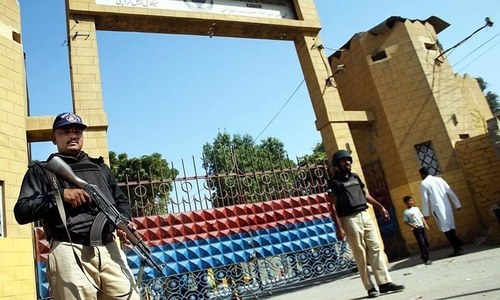
Four policemen were gunned down in Karachi's SITE area on Friday in what appeared to be an incident of target killing, officials told Dawn.
SITE Station House Officer (SHO) Rana Maqsood said the policemen were having iftar at a hotel located between Siemens Chowk and Habib Bank Chowrangi when three unidentified persons on two motorbikes opened fire on them.
The police officers ─ Assitant Sub-Inspector Muhammad Yousuf, and police constables Shabir, Khalid and Israr ─ died on the spot while the suspects managed to escape.
Maqsood initially claimed that the assailants belonged to a "defunct terrorist organisation".
However, Counter Terrorism Department (CTD) official Raja Umer Khattab told Dawn that a new militant organisation called the Jamaat-ul-Ansar Al-Sharia Pakistan had claimed responsibility for the attack on the policemen in pamphlets dropped at the site of the shooting.
Members of the militant outfit had doubled back to the crime scene after the attack and dropped pamphlets claiming responsibility for the attack, Khattab said.
Khattab said that the militant organisation was "newly established" and had previously claimed responsibility for the murder of a retired army officer in Karachi.
Senior Superintendent Police (SSP) West Nasir Aftab reached the site of the attack to investigate the incident.
Sindh Chief Minister Murad Ali Shah, taking notice of the attack said, "We will not let the spilled blood of our policemen go in vain."
Two policemen injured in Ibrahim Hyderi
In a separate incident in Karachi's Ibrahim Hyderi area, two policemen were beaten and wounded Friday evening after getting into a tussle.
The wounded police officers were identified as Kamal Din and Rahim Bux, police said.
Karachi operation
The ‘operation’ against criminal elements in Pakistan’s commercial hub was initiated back in September 2013 after the federal cabinet empowered Rangers to lead a targeted advance with the support of police against criminals already identified by federal military and civilian agencies for their alleged involvement in targeted killings, kidnappings for ransom, extortion and terrorism in Karachi.
A high-level apex committee meeting chaired by then chief of army staff Raheel Sharif on May 14, 2015 decided to implement effective policing and surveillance in the "vast suburbs of Karachi", to prevent what the military spokesperson said were "sneaking terrorist attacks".
Amid resentment and criticism from certain political circles over the ‘Karachi operation’, the military establishment in August 2015 said that there would be no let-up in actions by law enforcement agencies “to ensure a peaceful and terror-free Karachi”.
Although terror-related incidents have been reduced up to 60 per cent in the years since the commencement of the Karachi operation, according to police, sleeper cells of terror outfits still exist in the metropolis and law enforcers have been making concerted efforts to eliminate the same.
Correction: An earlier version of this story said that two policemen had been shot in a separate targeted incident. The error is regretted.