Col Habib’s case can’t be taken to ICJ, UN: minister

ISLAMABAD: A minister told the Senate on Wednesday that the issue of ‘kidnapping’ of a retired army officer in Nepal some two months ago could not be taken to the International Court of Justice (ICJ) or the United Nations ‘on the basis of assumptions’.
Minister for States and Frontier Regions retired Gen Abdul Qadir Baloch candidly conceded that it was yet to be established that retired Lt Col Habib had been picked up by the Indian forces. “No final report suggesting that the Indian intelligence agency (RAW) or the Indian government was involved is available with the Foreign Office or the government,” he said while winding up a discussion on an adjournment motion.
Senate Chairman Mian Raza Rabbani asked if the statement meant that the Foreign Office was exonerating India from the kidnapping of retired Col Habib as the minister had admitted absence of concrete evidence.
Aziz to brief Senate on Qatar crisis, hostile statement of Afghan president
Gen Baloch replied that he was not saying that. “We are hundred per cent sure that Indian intelligence agency RAW is behind the kidnapping, but the evidence to this effect is not final.”
He said that the issue appeared to have a link with the conviction of Indian spy Kulbushan Jadhav, but stressed that material was required to legally prove it.
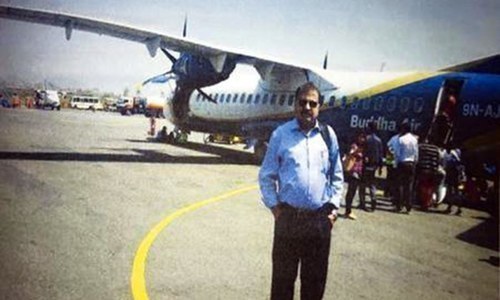
He said that the Foreign Office was trying to obtain solid evidence and the Nepalese government had been asked to get in touch with three Indian nationals who had received retired Lt Col Habib at the airport.
He said that it was still not clear whether the three people were Indian government employees or civilians or working for a private firm. The matter has also been taken up with the Indian government.
The minister said that the incident took place two months ago, but expressed his helplessness about non-cooperation from Nepal by saying that no sovereign country could be pressurised.
The Senate chairman stressed that everything should come before the parliament. He directed Adviser on Foreign Affairs Sartaj Aziz to brief the house on the steps taken by the government in the case of mysterious disappearance of retd Col Habib in Nepal, the current regional situation with a particular reference to Qatar crisis and the recent hostile statement by the Afghan president and the response of Pakistan’s military establishment on Thursday (today).
Leader of the Opposition in the Senate Aitzaz Ahsan noted that Nepal was not extending cooperation on the issue of retd Col Habib as it used to do in the past. He said that besides arch rival India, Pakistan’s relations were already strained with Iran and Afghanistan and now Nepal was the fourth country in the region with which Pakistan had tense relations. “This is the foreign policy of the Nawaz Sharif government,” he remarked.
Mr Ahsan said that though Jadhav was a terrorist, the Indian government had taken his matter to the ICJ.
Mover of the motion Atiq Ahmad Sheikh asked what the government had so far done for retd Col Habib’s recovery, warning that the situation might compel “Pindi boys and freedom fighters to take action” in this regard. “May be the Pindi boys and the Inter-Service Intelligence (ISI) are doing something for his recovery,” he said.
Senator Rehman Malik of the PPP said that it was not a matter involving only the ISI or the Military Intelligence and urged the government to take the issue to the ICJ and the UN.
Sherry Rehman of the same party said that India continued to use Nepal as a proxy but the government did not say anything on it. “Is it for the armed forces only to issue policy statements on each matter,” she asked.
She alleged that the country’s foreign policy had been ‘set on auto pilot’.
Published in Dawn, June 8th, 2017