Pakistani mountaineer returns after conquering Everest


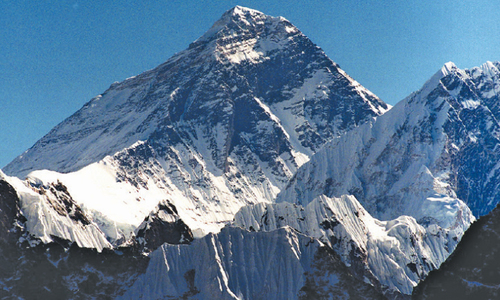
Pakistani mountaineer Abdul Jabbar Bhatti, the retired colonel who recently became only the fourth Pakistani to summit the world's highest peak, Mount Everest, on Thursday said he was proud to arrive back home after accomplishing the feat.
“I'm really happy to have hoisted our national flag atop Mount Everest. These are proud moments for me,” he told media after his arrival at the Islamabad Airport.
It was notable that there were no government officials, or anyone from the Pakistan Sports Board there to receive the mountaineer at the airport.
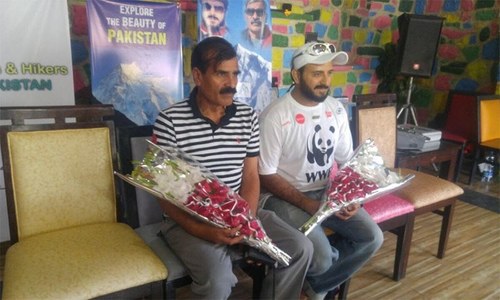
Explore: Two Pakistani mountaineers set their eyes on Mount Everest
Sleeping without oxygen at over 8,500 metres
Upon his arrival, Bhatti spoke to BBC Urdu and DawnNews about his ordeal climbing the world's highest mountain.
He revealed that his porter, instead of taking three bottled oxygen tanks, carried only one, resulting in a serious shortage of oxygen. Shockingly, Bhatti said this meant he was forced to spend one night at a height of 8,500 metres without any oxygen.
Bhatti's porter had previously said via Facebook that the retired colonel insisted on scaling Everest, despite his repeated requests to back down because of bad weather.
However, Bhatti refuted the porters claims. He told BBC Urdu; "The porter asked me to stand down when we were still not very high up the mountain. I asked him why he wasted my time and money if he couldn't scale the mountain. When we reached closer to the summit, we ran out of oxygen and the weather was also becoming unfavourable. That's when I told him we should go back down, but he insisted we should climb to the top."
On his way back down, Bhatti was in dire need of rescue. Thanking God, Bhatti revealed that five individuals helped him get back down from 8,600 metres to safety.
Before arriving in Islamabad, Bhatti underwent one week treatment at a hospital in Kathmandu.
“The way I was assisted by the people there is indescribable,” he said.
Bhatti, who himself managed the finances of the Rs6 million trip, said he was thankful to the people of Pakistan as right from the outset of his voyage they had been praying for his success and safe return.
Bhatti, however, was not alone in this historic journey.
Saad's abandoned journey
His companion, Mohammad Saad, who had embarked on the trek along with Bhatti, was forced to abandon his attempt to summit Mount Everest for the sake of his injured fellow climber.
“The expedition manager said it would be better if I called off my attempt to summit Everest and assist my fellow Pakistani climber, who was in dire need of medical assistance,” Saad told Dawn over the phone from Kathmandu, the disappointment palpable in his voice.
It is pertinent to mention here that Bhatti has successfully scaled Broad Peak (8,051 metres high) in 1985; Gasherbrum 2 (8,035m) in 1986 and Spantik Peak (7,027m) in 2012.
Prior to him, Pakistani mountaineers Nazir Sabir, Hasan Sadpara and Samina Baig have submitted Everest.