110
110

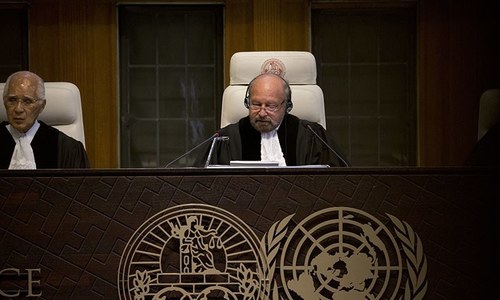
ISLAMABAD: Though Pakistani officials seem confident of their chances before the International Court of Justice (ICJ) despite the reprieve granted to India, legal experts at home have assailed the way the world court handled the case of Indian spy Kulbhushan Jadhav.
Explore: Criticism at home over ICJ decision on Jadhav
Former Pakistan Bar Council Vice Chairman Dr Farogh Naseem was of the view that Pakistan should have immediately withdrawn its March 29, 2017 declaration accepting the compulsory jurisdiction of the ICJ. Instead of contesting the matter, this should have been done immediately after the Indians took Jadhav’s case to the ICJ, he said.
Why did Pakistan not take the glaring and brutal human rights violations in India-held Kashmir before the court, despite the fact that Islamabad had a strong case in this regard, he asked, then answered his own question, saying that India had not conceded to the court’s compulsory jurisdiction in this matter.
This point of view was also shared by former Additional Attorney General Tariq Khokhar, an expert in international law. He regretted that Pakistan had accepted ICJ jurisdiction through a declaration, which should have been withdrawn once Pakistan knew India would invoke the ICJ’s jurisdiction against it.
Being an arbitration forum, each contesting state was allowed to nominate one person of its choice to act as an ad hoc judge at the ICJ, Mr Khokhar recalled.
India did nominate one but Pakistan did not, he regretted, adding that Pakistan’s counsel did not argue for the full allotted time either. He deplored these failures, and asked: “How can we not execute a foreign terrorist who was nabbed red-handed when we are hanging our terrorists?”
Read: Who is Kulbhushan Jadhav?
Human rights activist Asma Jahangir suggested that rather than making the ICJ ruling a matter of ego, “We should sit down, join our heads and find a way out by going through the ruling thoroughly”.
“Who gave the opinion to deny consular access to Jadhav in the first place,” she questioned, and asked whether this was in the interest of the country. “Will it not endanger the rights of the prisoners languishing in Indian jails? Can one change international law?”
Another senior counsel, on condition of anonymity, said the only way out for Pakistan was to contest the court’s jurisdiction and assure it that Pakistan had no immediate plans to execute Jadhav in a manner which may upend ICJ proceedings.
Pakistan should also request a fast-track hearing and consider holding a fresh trial for the spy in civilian courts by quashing the conviction handed down by the military court, he said.
Referring to ICJ’s restraining order, he said: “Sadly, it is a resounding and unqualified defeat.”
He was also of the view that the national security exception in the 2008 bilateral agreement between the two countries, which Pakistan was banking on, was only applicable to additional safeguards provided under the agreement. This agreement and the exception could not supersede the Vienna Convention on Consular Relations (VCCR) 1963, he said.
Examine: 'Pakistan didn't fail': 5 things you should know about ICJ's decision on Jadhav
International law expert Ahmer Bilal Soofi was of the view that Pakistan should prepare for the second phase of this case, which was more important because it would be contested on merit and would provide Pakistan the chance to document India’s intervention inside Pakistan through Jadhav.
Islamabad could insist on cooperation from India on the investigation into Jadhav’s activities, he said, adding that Pakistan should also argue that the national security exception in the 2008 bilateral agreement was binding.
But former law minister legal expert S.M. Zafar said that prime facie, it was a wrong decision.
“I could not understand why the ICJ issued a stay order in the Jadhav case without even understanding the case,” he said.
“After reading the order sheet, what I could understand was that the ICJ issued the stay order saying that since the parties in the dispute could not convey their point of view and the court needs further assistance from both countries,” he said.
Though Mr Zafar said that the restraining order was not binding on Pakistan, it was considered a strong opinion.
According to him, Pakistan should change its legal strategy and should concentrate more on the terrorism angle.
Retired Justice Wajihuddin Ahmed also termed the ICJ order “poor”. “Even a civil judge of the subordinate judiciary would not handle the case the way the ICJ did,” he said.
“The court’s job is to examine the case and pass an appropriate order, it is not the role of a court to interact with the relevant quarters for the execution of that order,” he further said.
“I can conclude that this was a political decision, based on the influence of India with the international community,” he said.
Barrister Masroor Shah opined that the ICJ order was not based on any statute or legal precedence.
Published in Dawn, May 19th, 2017