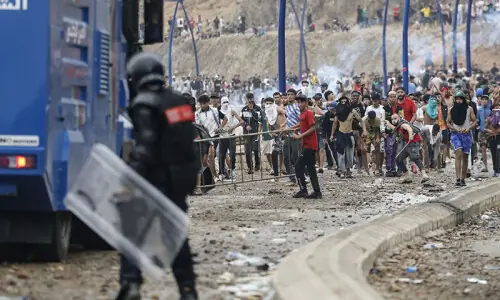
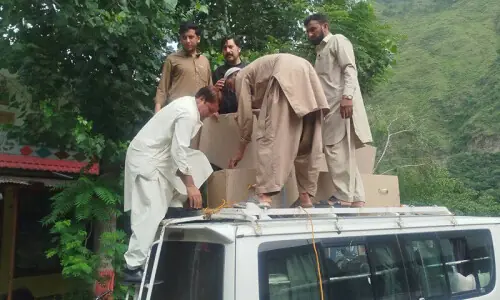
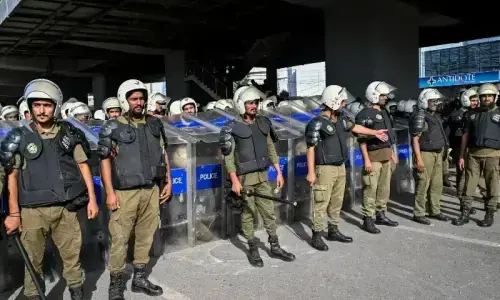
PAKISTAN wants its Afghan refugees to go home. The repatriation numbers are staggering: more than 600,000 Afghan refugees are said to have returned home from Pakistan in 2016, to a country still under attack by the Afghan Taliban. In April alone, at least 140 soldiers and military officers died in an assault on an Afghan military base, the deadliest such attack since 2001.
The ‘voluntary’ repatriation of Afghan refugees is in truth often forced, achieved by harassment — through police extortion and bribery, raids and confiscation of legal documents, making the legal status of many insecure and temporary. This violates the tripartite agreement between the UNHCR, the refugee agency and the Pakistan and Afghan governments.
The thread that runs through this is Pakistan’s narrative on Afghan refugees — ‘economic burdens’, ‘criminals’ and ‘terrorists’ — the latter being the latest refrain. After the APS, Peshawar, attack, the National Action Plan called for a “comprehensive policy for Afghan refugees, beginning with their registration” — thus linking them with the plan to counter terrorism and extremism in Pakistan.
This conflation of refugees with terrorism is disingenuous (and hypocritical, given our derision of the West’s parallel right-wing narrative on refugees). What is true is that Operation Zarb-i-Azb drove the Tehreek-i-Taliban Pakistan (TTP) out of the tribal areas into Afghanistan, from where they are now planning and conducting attacks on Pakistan. But are they Afghan? No. And are they linked with Afghan refugees who have lived in Pakistan for decades? Again, no.
In between the blame game rests the fate of millions.
This narrative furthers our obfuscation on extremism — blaming attacks conducted by the TTP on other countries, mainly India and the US. Refugees serve as yet another scapegoat, a convenient foil that will inhibit the battle against extremism that must be waged within.
For years, Afghanistan has blamed Pakistan for attacks on its soil — planned by the Afghan Taliban, many of whom had taken sanctuary in Pakistan after being driven out of Afghanistan by the US since 2001. Pakistan now blames Afghanistan of the same thing with regard to the TTP.
But these duelling Afghan and Pakistani narratives are one-sided. There is complicity on both sides of their long, complex history — though arguably more on Pakistan’s side. Following the Soviet-Afghan war, Pakistan supported the Afghan Taliban in the ensuing power struggle. The Afghan Taliban had brought forth another dark period in Afghanistan, leading to the 2001 US invasion of the country and the war that followed. To date, Afghanistan alleges that Pakistan allows the Taliban sanctuary on its soil from where they plan attacks on the former country.
On the other hand, Afghanistan would do well to remember that Pakistan has graciously hosted millions of its refugees over the past four decades, even as it has itself been stressed economically, and, more recently, in terms of security. And Afghanistan could also now deny sanctuary to the TTP, but it has apparently not done so.
It is time for Pakistan to change its narrative and, better still, its policy towards the refugees from Afghanistan. From a cynical perspective, driving refugees out further harms the country’s image internationally. But from the more important moral perspective, returning them to a place where they will be insecure is unconscionable.
Pakistan’s policy towards refugees has always been inadequate. Consider the children of Afghan refugees born in Pakistan, for whom this has been the only home they have ever known. They have no path to naturalisation. Of those born in Pakistan, only children of Pakistani parents are legally entitled to citizenship.
Pakistan is not a signatory to the 1951 Convention relating to the status of refugees, which calls for their assimilation and naturalisation. When Afghan refugees are registered here, they can get a Proof of Registration card that recognises them as “Afghan citizens temporarily residing in Pakistan”.
But the Afghan conflict has dragged on for more than 40 years, and there is no end in sight. Given that Pakistan has been home to millions of Afghan refugees for decades, it would do well to offer those who want to stay a path to naturalisation, and economic and social integration.
When Pakistan’s own population is stretched, and many of the country’s own are ‘otherised’ and marginalised, one may wonder whether we can extend our hand to refugees. If we do, we can offer an example to an increasingly xenophobic world intent on closing down borders. We may well find that a nation that takes on the responsibility of others with humanity and empathy finds a clearer path to overcoming its own demons.
The writer teaches at the University of Maryland, and is a Brookings Institution non-resident fellow.
Twitter: @MadihaAfzal
Published in Dawn, May 17th, 2017