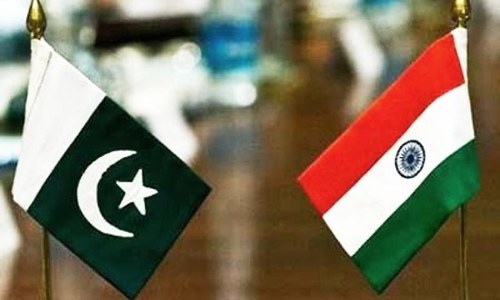
Federal Minister for Water and Power Khawaja Asif urged India and Pakistan to respect the Indus Waters Treaty, saying it is in the interest of both countries.
The minister held a press conference on Monday as talks commenced in Islamabad with an Indian delegation regarding the designs, disputed by Pakistan, of the three controversial water projects being built on River Chenab.
A 10-member Indian delegation led by Indian Indus Water Commissioner P.P. Saxena arrived on Sunday for two-day talks.
The talks will resume two years after water experts of the two sides last met in May 2015 in New Delhi at the level of Permanent Indus Commission. However, due to the tense bilateral ties, it could not hold mandatory annual meetings since then despite repeated requests by Islamabad.
The Pakistani delegation is being led by Pakistan’s Indus Water Commissioner Mirza Asif Beg.
Know more: India resists World Bank move to resolve Indus Water Treaty dispute
Addressing the media, Asif said that the talks would focus on three power projects with varying capacities of power generation: Pakul Dal (1,000MW), Miyar (120MW) and Lower Kalnai (48MW).
"To respect this agreement [the Indus Waters Treaty] and find a solution through it is in the interest of both countries," the minister said.
The minister also spoke about the controversial Kishanganga and Ratle hydroelectric projects for which Pakistan is seeking international court of arbitration (ICA) through the World Bank.
Asif said delays had been witnessed in the past in the handling of the Kishanganga project.
The minister claimed that, "When we [Pakistan] went to the court of arbitration our position was not as strong as it could have been if we had approached the court in a timely manner."
However, he added that the country's position regarding the Ratle project is "very strong."
"We are working to make changes to the design of the project that are in Pakistan's interest and which are in accordance with the treaty," the minister said.
"Since the Indus Waters Treaty was signed [in 1960], no dispute has been handled including the Ratle dam dispute," Asif said, adding, "We are in the position to fully protect our interests."
The two sides would not discuss the controversial Kishanganga and Ratle hydropower projects on which Pakistan is seeking international court of arbitration (ICA) through the World Bank, a senior official earlier told Dawn.
The teams led by Mr Saxena and Pakistan’s Indus Water Commissioner Mirza Asif Beg would open formal talks on Monday before leaving for Lahore in the evening where the talks would conclude on Tuesday. The visiting delegation would leave for New Delhi the same day.