JALOZAI: A wander through the narrow, unpaved streets of this Turkmen Afghan refugee camp feels like walking through a ghost town. The dirt lanes are lined with crumbling mud-and-stone homes, abandoned by refugees who chose, under a campaign of increasing pressure from Pakistani authorities, to repatriate to their native Afghanistan. In some dwellings, people’s belongings are still visible through walls eroded by rain. An errant shoe, or a cloth waving in a doorway, are the only signs left of decades of a life lived in Pakistan.
Last year, more than 606,000 Afghan refugees repatriated to their native country, the highest number for more than 10 years, according to the United Nations High Commissioner for Refugees (UNHCR) and the International Organisation for Migration (IOM). In terms of registered refugees, it was a six-fold increase from the year before, when only 58,211 repatriated. Those who repatriated willingly in 2016 were also joined by 22,559 people who were deported, according to the IOM.
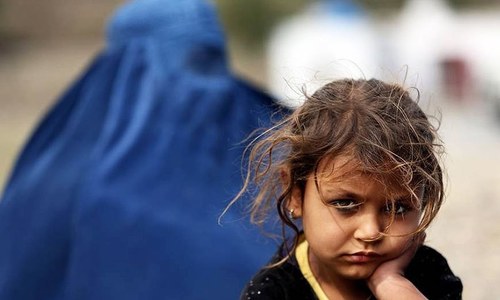
Once, not long ago, this camp was bustling with activity. When it was established in 2002, it was home to more than 25,000 refugees, says 49-year-old Shahzada Khan, who heads the committee that runs the camp. Today, only about 3,500 people remain. The rest have fled what residents describe as a sustained campaign of harassment, abuse and threats by Pakistani authorities over the last two years.
This campaign, they say, has intensified since a series of attacks in February killed more than 120 people across Pakistan, most of them at a shrine in Sehwan Sharif.
“Many people have been picked up from our village,” says Khan’s son Hafiz Ahmed, 22, describing police raids on the refugee camp since the Sehwan attack. “The police have taken them even if they had [refugee registration] cards. In some cases, they even cut up their registration cards. We are afraid to leave the house — they might jail us [by] implicating us in some attack.”
Since last week, the committee that runs the camp has decided that no refugees are to take the risk of venturing into Peshawar, located about 35km away.
“We do not even take Peshawar’s name! Even if we have to go to the hospital, we tell the police beforehand,” says Ahmed.
Ahmed’s account is consistent with the state’s own rhetoric, often painting Afghans as a security risk. In the security sweeps since the Sehwan, Lahore and Mohmand attacks, scores of Afghan refugees have been arrested, the police and military say, and the issue of Afghan involvement in attacks on Pakistani soil has been raised by both the Foreign Office and the military.
The latest raids, however, appear to be part of an ongoing campaign targeting refugees, one that started in 2015 following the Army Public School (APS) attack. Extensions to the refugees’ government-issued registration cards — their right to remain — have grown shorter in duration. Where once deadlines for repatriation were extended for two or three years as a matter of course, that period has now come down to months at a time.
The lack of clarity on refugees’ right to remain has also emboldened the police to challenge Afghans, many say, since most have not been issued new cards with the updated deadline. “The [refugee registration] card is now just like this piece of paper,” says Khan, touching a page of my notepad. “And it can be torn up just as easily.”
Pakistan has been hosting millions of refugees for more than 30 years. At its peak, Pakistan was home to at least five million Afghans. Today, at least 1.3 million registered refugees remain. (The number of undocumented migrants remains unclear.) Generations of Afghans have been born in Pakistan, grew up here and say that for all intents and purposes, they are Pakistani.
“My life’s best moments, from playing in the streets as a child to my schooling, college and now university are in Pakistan,” says Khalid Amiri, 22, whose family fled Jalalabad when he was just two years old. “People accepted us. We played in the same playgrounds. My friends used to come to my house. They would meet my mother, I would go visit them. But after [the APS attack], there was a sponsored, state-oriented campaign against us. Afghans may not like it if we say that we feel Pakistani, but we do feel it. It is the truth. We live like Pakistanis. We live in the Pakistani culture.”
Young refugees’ identity is caught in flux — knowing little of a homeland they’re constantly told to return to, rejected by the only home they’ve ever known.
“If I go to Afghanistan, it’ll be very difficult for me there,” says Abdul Rashid, 21, who is just starting his Bachelor’s degree at the University of Peshawar. “I don’t speak Farsi, I don’t know of Afghan history, I don’t know of their education system. It would feel like a foreign land.”
As we speak, back at the Turkmen refugee camp, Hafiz Ahmed grows animated, talking about how he loves Pakistan “so much so that I cannot describe it”.
“Why don’t you become Pakistani, then?” someone asks.
“I want to,” he says, quietly. “But they won’t let me.”
The writer is Al Jazeera’s web correspondent in Pakistan.
Published in Dawn, March 3rd, 2017