0
0

2003 marked the second consecutive year of the City District Government of Karachi (CDGK) in the office since 14 August 2001 onwards. Under the framework of Sindh Local Government Ordinance (SLGO) 2001, the CDGK was in the driving seat of urban administration of Karachi, at least theoretically.
Although the advent of a quasi- elected provincial government in Sindh in the wake of October 2002 elections created problems due to political rivalries, the unabated support from the President to the local government in Karachi and elsewhere provided a lease of life to the existence of this most vulnerable tier of governance. Devolution of various autonomous institutions such as Karachi Development Authority and Malir & Lyari Development Authorities added clout to the CDGK operations. The performance of the CDGK vis-a-vis the overall developmental scene in the city displayed a mixed outcome.
Many pragmatic development practitioners and critics had hoped that CDGK shall soon take a lead role in spelling out development priorities of the city from a holistic perspective. This anticipation was well founded from the fact that in the following years, the CDGK shall have to seek a fresh mandate from the people. Generally,the possibility of re-election is subject to the perception of performance as viewed by people. Several short comings prevailed in this respect.
Whereas the CDGK itself failed to come up with an overall vision of urban development and management of the city, it continued to act as a partner and facilitator to various projects and programmes funded and executed by the federal government and its institutions. The grossly unpopular Lyari Expressway is a key example in this reference. Launched on the basis of a previous alternative plan by the erstwhile KMC administration of 1990s, the project got a swift jump start due to the continued pressure of federal government in 2001. The project aimed to facilitate motorists and transport community of the already over densely populated old town areas. It directly affected over 200,000 people through evictions and at least an equal number of labourers and workers who are likely to lose their livelihood. Large scale resistance by the area community, political solidarity expressed by various parties through several sessions at local scale, all parties conferences, litigations at various levels, concern cited by international organizations including United Nations, lack of transparency in the award of contracts and a controversial layout and engineering design lent the project sizable discredit. To date it has not been made clear that how this project shall be used in streamlining the traffic particularly the goods carriers.
As the CDGK has explicitly announced, the Lyari Expressway shall not be used for heavy traffic, its utility has become all the more dubious.
In addition to Lyari Expressway, the Karachi Northern Bypass Project is also being undertaken by the National Highway Authority (NHA) with minimum involvement of CDGK in execution. The project, which is targeted to be completed in October 2004, is progressing.
The project is aimed to facilitate the heavy vehicles from the port to super highway without entering into city streets. Karachi Circular Railways (KCR) project remained in the doldrums despite several claims made for its revival by various tiers of the government. It is estimated to be revived at a cost of Rs 12 billion. The project is entangled in several bureaucratic snags that are an outcome of weak political will. Lack of coordination between Sindh Government and the Railways has resulted in institutional hang-ups. It is obvious that the powerful lobby of the road transporters and their representatives have been able to influence the government to adopt a ‘go slow’ policy. As a means of cheap transport aimed to directly benefit the poor and lower income groups, the project has yet to come out of mere paper existence to an implementation time table.
Advent of new bus companies that started plying the buses on various routes of the city was indeed a welcome sign. These companies, through an initial administrative assistance of the CDGK, began operation more than a year ago. Their track record during this semi-pilot run has been found satisfactory. In a bid to expand their operations, they need appropriate spaces for terminals, workshops and on-the-way bus shades. Despite continuing attempts by the management of these companies, a suitable solution to this crucial issue is not forthcoming.
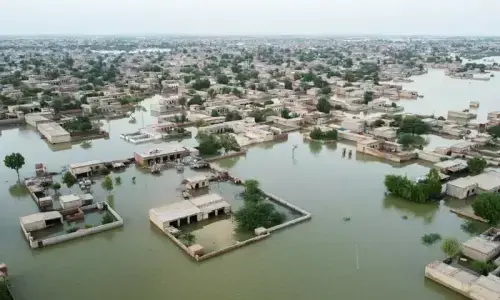
Few flyover projects got underway at three points on Shahrah-e-Faisal. More such projects are planned. However, the overall urban public transport sector displayed an all chaotic appearance. The heavy monsoon rains during July-August 2003 badly damaged the main streets of the city. University Road, for example, was entirely damaged for four months causing utmost hardships to commuters. Repairs could only be done at snail’s pace through patch work carpeting. It was ironic to note that while billions of rupees were spent on a single expressway project, not even a fraction was allocated to re-build the already existing central arteries. The Mauripur-Gulbai Section catering to heavy traffic still provides a dismal picture of transport planning and management.
Rainfall at least brought the good fortune to the CDGK and KWSB (now tagged as WSD). The Hub Dam was filled down to its optimum level giving the indication of availability of adequate water at source for sometime. It was proudly announced by the Nazim and Managing Director of KWSB that this level shall be enough to feed a targeted supply of 100 million gallons per day (mgd) to the western parts of the city. Several experts have fastidiously stated that only filling the dam is not a solution to water woes of Lyari, Orangi, Baldia, SITE and the main areas covered by Hub river. Due to ages of neglect and ill directioned construction works, internal distribution system has broken down.
Before releasing water, a massive repair and maintenance work is needed with proper survey and estimation. Not long ago in 1996, when water from Hub was released to some areas in Orangi, many roads and lanes were inundated due to damaged pipelines.
Water supply is planned to be augmented by an additional 100 million gallons per day (mgd) after the completion K-III Bulk Water Supply Project from Indus-Kalri source, currently in progress. It may be noted that although addition to existing quantities of water is vital, greater emphasis needs to be put on improving the retail distribution process to lanes and households. Operational defects such as thefts and leakages that still account for a wastage of 30-35 per cent of the total supply, need to be addressed. CDGK is planning to close down its hydrants in Gulshan-i-Iqbal and elsewhere to help protect the roads damaged by tankers and also to extend adequate piped supply to its residents. However, without ensuring the reliability of piped system, doing away with hydrants may not prove a viable option.
The sectors where the city government and its lower tiers have failed to deliver are solid waste management and sewerage. The city literally appears to be an extension of a big waste land in many of its localities. Apparently, the division of responsibilities between the internal tiers of local government did not work efficiently. The union councils were supposed to organise garbage picking from household to an area bin (kundi). Town councils were to lift this garbage and transport it to the landfill site. The CDGK was to coordinate the landfill site development and the overall system. However, the system is showing signs of serious weakness. Distribution of collection vehicles and equipment among towns, long distances to landfill involving high transportation costs, lack of proper planning, absence of trained manpower (especially at the level of supervisor of field operations), huge backlog piles of waste and indiscriminate burning of garbage have caused colossal problems for this sector. These problems are far from over.
In the days of KMC, several high profile consultancy assignments were done to assess the solid waste situation and find out solutions. So far, it appears, the wisdom shared by the foreign consultants of those times is locked some where in official cup boards. The more chronic issues related to safe disposal of hospital waste, installation of municipal incinerators for public sector hospitals, appropriate siting of re-cycling industry in the proximity of landfill, cleaning solid waste from large drains and scientific location assessment for garbage transfer stations remained largely unattended.
The issues related to governance and institutional re-organisation were marginally addressed. Karachi Water and Sewerage Board has not been fully devolved adding managerial and technical problems for the city. Several heated debates took place in the city council to address this issue.
The Nazim and Town Municipal Administrations are of the view that they face the masses during break down in service or complaints on other related issues on which they have no control. The quarters at KWSB contend that due to the integrated nature of service delivery, devolution is a difficult proposition and will take time. The status quo therefore prevails, Karachi Building Control Authority (KBCA) has a specific city bound set of functions, although notified under Sindh Building Control Ordinance of 1979. It has been at logger heads with CDGK, obviously at the behest of provincial government. Although the devolution plan under SLGO, 2001 clearly gives the city and town administration the mandate to look after planning and building control affairs, parallel existence of bodies refrains them to follow any coordinated path.
It is also disappointing to note that the CDGK has not made any effort to revive the long stalled city planning process for the city. Besides the citizen community boards are also yet to be formed although they were assigned the vital tasks of improving service delivery by concerned public utilities; development and management of new public facilities; finding out ways and means for the welfare of the handicapped, destitute and extremely poor; establishing marketing and consumer cooperatives; identification of development needs and mobilization of resources; forming stakeholder associations and supporting the city/town councils in the functions of monitoring.
Few issues need a priority consideration in respect of the overall scenario of urban development in Karachi. The CDGK must initiate an appropriate city planning process for the city. This can only be done if a planning institution for the city is created with strong professional capacity, administrative writ and financial investment. Once created and managed by competent professionals, this institution must be given the opportunity to draw its own terms of reference in consultation with the concerned stakeholders. Vital needs of the citizens should be carefully analysed to come up with appropriate alternatives to address them at the planning stage.
CDGK must be given jurisdiction on building and town planning control in order to allow it implement what it plans. Snags from some of the most crucial schemes must be removed. Karachi Circular Railways must be revived in correspondence with the engineering designs recently reviewed and endorsed by the CDGK. And the city government must study the various pilot projects and schemes that have yielded remarkable results in addressing crucial urban problems, be they related to housing or micro finance. Such successfully demonstrated projects should form the basis for preparing city plans for the future.