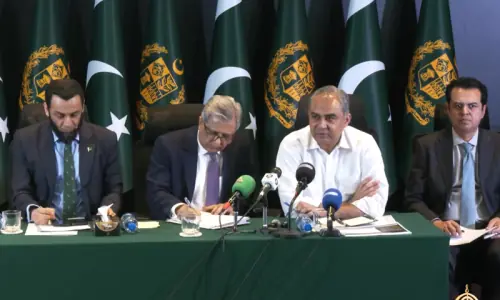
Corruption not to be tolerated, says incoming chief justice

ISLAMABAD: Chief Justice-designate Mian Saqib Nisar on Thursday sent a loud and clear message to all and sundry that the judiciary would not tolerate corruption and play a part in eradicating this menace from other sections of the government.
“The act of corruption by state actors is a complete fraud on the exercise of their power may it be the executive or judicial limbs of the state,” Justice Nisar observed, cautioning that it should be very clearly understood that besides cleaning ‘‘our own house of corruption, the judiciary would play its role in the eradication of corruption from other limbs of the government’’.
Many believed that Justice Nisar through his speech has provided an insight into his plan of action.
Justice Nisar was speaking at a full court reference hosted in honour of outgoing Chief Justice Anwar Zaheer Jamali in a packed-to-capacity Courtroom No 1.
Attorney General Aushtar Ausaf, Pakistan Bar Council vice-president Dr Farogh Naseem and Supreme Court Bar Association president Rasheed A. Rizvi praised the role played by the chief justice, but expressed the need for reviving the institution of the Supreme Judicial Council to purge the judiciary of incompetent and dishonest judges.
Justice Nisar observed that corruption was one of the greatest vices of any society and said corrupt action was described as dishonesty of purpose. “It taints the very fabric of society and the state but to end this menace, very honest actions and vigilance are required,” he said.
He stressed the need for updating the investigating mechanism and the tools and said that laws pertaining to the standard of proof should also be brought in line with those countries where corruption had been effectively combated.
“We owe this duty to our nation and posterity and in this endeavour we need the continuing support of the people who must say no to corruption,” he said.
Justice Nisar said that the superior court judges had taken the oath to preserve, protect and defend the Constitution and it would be their promise on account of their sacred oath that the Constitution would be protected in letter and spirit and they would ward off any challenge to democracy in the country.
Referring to the court’s extra ordinary jurisdiction under Article 184(3) of the Constitution, he observed that while exercising this jurisdiction, the court often examined the executive actions of state functionaries to pass effective orders. At times the legislative actions of parliament, including subordinate legislation, had been examined and declared to be ultra vires (against the law), he said, adding that this was a very important role of the judiciary which had been performed in the past and would be pursued with greater passion and vigilance in the times ahead.
“It is important that the judiciary is impartial and free from all sorts of external pressures and influence,” he said, adding that “only then can the public have confidence that their cases will be decided in accordance with law”.
Justice Nisar also touched upon the issue of the public interest litigation (PIL) and said bona fide PIL for the purpose of alleviating miseries of the downtrodden class of society, which was either unaware of its rights or more often did not have the resources to approach the judiciary, including the rights of minorities, would be encouraged.
“I am deeply conscious of the fact ….. that it is our moral and legal duty to fiercely uphold the rights of all minorities, including religious minorities,” Justice Nisar observed and said that as the custodian and guardian of such rights, this court would ensure their enforcement, including women’s rights, in a meaningful manner.
Earlier, Chief Justice Jamali regretted that today’s Pakistan was not the one for which Muslims of the subcontinent had struggled and made sacrifices.
‘‘Not only foreign powers but our follies too were responsible for the deteriorating law and order and terrorism in the country,’’ the outgoing chief justice lamented. He said the people of the country had not learnt any lesson from their past mistakes which resulted in the dismemberment of the country.
“Today anarchy, sectarianism, bigotry, hatred, nepotism, favouritism, maladministration and social injustice are rampant and become order of the day thus promoting despondency and helplessness among the people — a situation that may, God forbid, lead to a bigger tragedy,” he bemoaned.
Published in Dawn, December 16th, 2016