Lack of heavy vehicles badly affects Edhi Foundation’s work
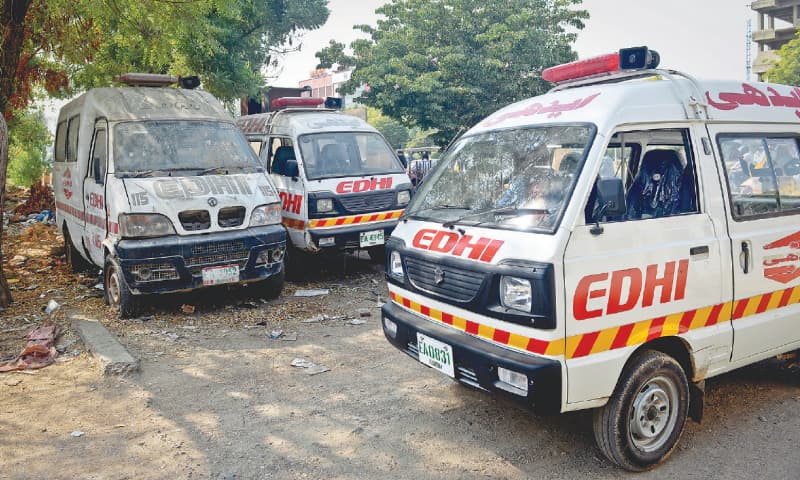


KARACHI: Rescue operations of the Edhi Foundation have come to a standstill as the country’s largest charity is waiting for the federal government’s approval to sell more than 300 of its heavy-duty vehicles in order to generate funds that could be utilised for buying new vehicles needed to replace the “obsolete and useless” ones, officials said.
The authorities in Islamabad have confirmed receiving requests from the Edhi Foundation, which is headquartered in Karachi, for immediate permission to sell the 300 vehicles that used to take part in its rescue operations. Because of lack of heavy vehicles the charity has been unable to effectively mount rescue operations.
This emerged recently in the wake of a suicide attack on the shrine of Bilawal Shah Noorani in a remote region of Khuzdar district in which more than 50 people were killed and scores of others injured.
“The situation at the shrine grew worse when the Edhi Foundation couldn’t mobilise its heavy-duty vehicles for survivors of the blast and the injured people,” said a health official when he was asked about delays in rescue and evacuation operations.
“At the time of the attack there were over 1,000 people at the shrine, who had reached there from across the country, particularly Karachi.... We all know the government’s resources and it’s the Edhi Foundation which always does the rescue work. But they also were helpless. They could only send their hi-roof vans [used as ambulances] which can never serve the rescue purpose.”
He said that makeshift ambulances from the Edhi Foundation and vehicles from other charities and government departments proceeded to bring the injured to Karachi, some 250km from the shrine. As a result, more than 12 people lost their lives, mainly due to excessive bleeding and delay in start of their treatment.
The charity’s rescue operations come to a standstill
“How can you expect a hi-roof van used as an ambulance to move the critically injured people to Karachi from that mountainous area more than 250m away within a few hours? It was simply impossible as the distance and the tough terrain required heavy-duty rescue vehicles,” said the official.
He said that in the past the foundation had been using stronger and better vehicles.
The situation set off alarm bells at hospitals in Karachi where doctors and paramedics kept receiving the injured till the next morning, more than 12 hours after the suicide attack.
Faisal Edhi echoed the concerns but what he described as the reason for the delays proved to be more shocking.
The chief of the country’s largest charity and son of Abdul Sattar Edhi said the Edhi Foundation’s rescue operations had largely come to a standstill more than seven months ago.
“The authorities concerned know this very well,” he told Dawn. “The Edhi Foundation right now is operating only within different cities, with a fleet of just over 1,500 vehicles. We have some 300 heavy vehicles which were once used for rescue operations in tough terrains, long-distance travelling and catering for more than one victim at a time.”
He said the 300 vehicles had become obsolete after being used for more than 16 years. The foundation had planned to sell them in order to generate funds needed to buy some new vehicles. But the plan was delayed due to the lack of interest on the part of federal government.
“Actually these vehicles were imported from Japan, South Korea and China between 1999 and 2001 and the-then government had supported the Edhi Foundation by removing all duties and taxes,” said Mr Edhi.
“Under the government regulations, we cannot sell them without the permission of the competent authority. We have requested the FBR [Federal Board of Revenue] and the finance ministry for permission a number of times but we have not received a single reply.”
He said he personally conveyed his concerns to all the “influential individuals” and “top officials concerned” in July when he was meeting them at his place after his father’s death.
“If the Shah Noorani incident fails to prove as a wakeup call, I fear we should not expect anything good in future. We should keep in mind that due to the problem the common man is suffering,” he added.
Published in Dawn November 19th, 2016