0
0

FRANKFURT: Images taken by a Nasa Mars orbiter indicate that a missing European space probe was destroyed on impact after plummeting to the surface of the Red Planet from a height of 2-4 km, the European Space Agency said on Friday.
The disc-shaped, 577-kg Schiaparelli probe, part of the Russian-European ExoMars programme to search for evidence of life on Mars, descended on Wednesday to test technologies for a rover that scientists hope to send to the surface of the planet in 2020.
But contact with the vehicle was lost around 50 seconds before the expected landing time, leaving its fate uncertain until the Nasa images were received.
“Schiaparelli reached the ground with a velocity that was much higher than it should have been, several hundred kilometres per hour, and was then unfortunately destroyed by the impact,” ExoMars Flight Director Michel Denis said.
It was only the second European attempt to land a craft on Mars, after a failed mission by the British landing craft Beagle 2 in 2003.
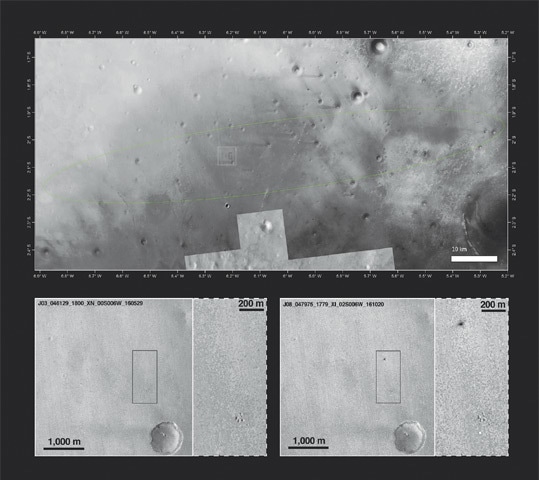
The US space agency’s Mars Reconnaissance Orbiter, which has been circling the planet for about 10 years, took low-resolution pictures that show a bright spot that ESA believes is the 12-metre parachute that Schiaparelli used to slow down. They also show a fuzzy dark patch, around 15 by 40 metres in size, about 1 km north of the parachute, which scientists interpret as having been created by the impact of the lander following a longer-than-planned free fall.
ESA said it was possible that Schiaparelli’s landing was accompanied by an explosion, as its thrusters’ fuel tanks were probably still full.
The primary part of the ExoMars mission has, however, been a success so far, as the Schiaparelli lander’s mothership has been brought into orbit around Mars, from where it will try to sniff out methane and other gases that might indicate the presence of life.
Published in Dawn, October 22nd, 2016