Meat for all households in Hunza: Eid tradition ensure equality in sacrifice



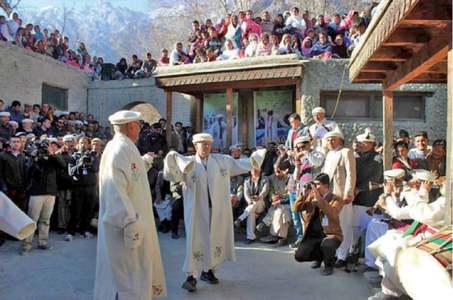
The much renowned Hunza valley, enveloped in the grand Himalayas and the Karakoram mountain range, carried out its unique tradition of communal qurbani on the occasion of Eidul Azha.
As part of an ancient tradition, all sacrificial animals are slaughtered at a community centre and the meat is then divided among the local population where all families get an equal share of meat, irrespective of whether they purchased a sacrificial animal or not.
This year around 130 sacrificial animals were slaughtered in the garden of the community centre where volunteers supervised the process. As part of the tradition, the owners of the animals remain anonymous.
“It’s a centuries old tradition,” said Sher Afzal, a resident of Ali Abad area of Hunza.
Afzal leads a group of volunteers which manages the process qurbani and the distribution of meat among local residents.
“We are happy and honoured to be following the practice of our forefathers,” he said.
Explaining the process of qurbani, Afzal said: “Local people have their own animals which they offer for qurbani...the names of people who offer their animals for sacrifice is kept secret.”
Afzal said “this year we had around 5,200 kilogrammes of meat which was then divided among 1,300 households”. Hence every household got 4 kilogrammes of meat.
A majority of the local population cannot afford animals for qurbani yet they are ensured an equal share of meat, he maintained.
The volunteers are tasked to ensure equal delivery of meat to each and every household.
“We divide volunteers into different groups and assign them areas for the door-to-door distribution of sacrificial meat,” said Afzal.
Piyar Ali, a resident of Ali Abad, said “We celebrate Eidul Azha keeping the concept of sacrifice in mind, and equally distribute the meat...this is the actual concept of sacrifice taught by Prophet Ibrahim (PBUH) and Prophet Ismail (PBUH),” another resident said.
“I cannot afford animal for qurbani but every year on Eid I receive meat,” he added.
Volunteer Sher Afzal said people in Hunza were following the centuries old tradition of qurbani, which he claims is also gaining popularity in other areas of Gilgit Baltistan.