In Delhi, the India-US Strategic and Commercial Dialogue; in Washington, the Logistics Exchange Memorandum of Agreement, one of four so-called foundational pacts the US signs with defence partners.
Taken together, this is yet another step towards a closer US-India strategic, defence and commercial relationship, a process kick-started a decade ago under a Congress-led coalition and now accelerating under a BJP government.
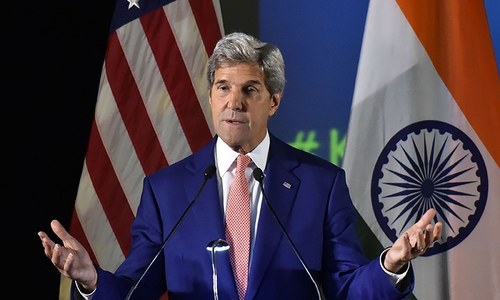
In the US, meanwhile, there is rare bipartisan consensus on deepening ties with India — hence, US Secretary of State John Kerry’s fulsome praise for India and the absence of any substantive comments on India-held Kashmir in New Delhi.
Meanwhile, a trilateral US-India-Afghanistan talks process is also to be restarted. Inside Pakistan, the developments are sure to be keenly followed in security circles, though perhaps India’s internal political opposition to deepening military ties with the US and concerns about unduly antagonising China are likely to be discounted.
Do the Indo-US moves really amount to a challenge for Pakistan’s security situation, however?
While it is to be regretted that not only has the US ignored the violence in IHK and India has aggressively tried to blame Pakistan for allegedly seeking to stoke trouble inside IHK, there is another reality that must be addressed.
On the terrorism front, it is true that Pakistan has suffered violence from the now Afghan-based anti-Pakistan militants and it does appear that India is willing to intrude deeper into Balochistan’s troubles. Yet, it is also true that Pakistan’s fight against militancy has not extended to anti-Afghan and anti-India militant groups operating from its soil.
That duality, whether implicit or officially unacknowledged, is problematic because these groups predate and post a bigger challenge to regional stability than anything the anti-Pakistan militants have been able to threaten.
The immense suffering of Pakistanis is equal to — in some cases even greater than — what neighbouring populations have endured, but the commonality is that all have suffered.
The foremost duty of the Pakistani state is to secure the homeland and the people of this country — but the security threat cannot be fought in isolation.
Consider that the Mumbai trials and Pathankot probe have effectively stalled and while there may be narrow, legalistic explanations for why that is the case, it appears to be a lack of will on the part of the state.
Troubling too is the space being accorded to pro-Kashmir, anti-India militants groups and their leadership here. When in many cases those leaders are either banned or indirectly linked to militancy, why are they being allowed to address public rallies and engage in political discourse?
Pakistani authorities rightly bristle at any attempt to sideline this country internationally. But security is neither one-dimensional nor country-specific. Terrorism is a common threat to the region and little will change if a piecemeal, ad hoc approach continues to prevail.
Published in Dawn September 1st, 2016