Erdogan shuts schools, charities in first state of emergency decree


ISTANBUL: President Tayyip Erdogan tightened his grip on Turkey on Saturday, ordering the closure of thousands of private schools, charities and other institutions in his first decree since imposing a state of emergency after the failed military coup.
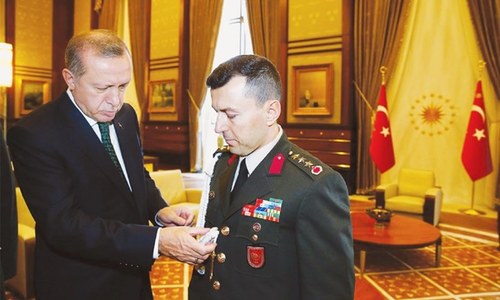
A restructuring of Turkey's once untouchable military also drew closer, with a planned meeting between Erdogan and the already purged top brass brought forward by several days.
The schools and other institutions are suspected by Turkish authorities of having links to U.S.-based Muslim preacher Fethullah Gulen, who has many followers in Turkey. Erdogan has accused Gulen of orchestrating the July 15 coup attempt in which at least 246 people were killed. Gulen denies the accusation.
Critics of Erdogan fear he is using the abortive coup to wage an indiscriminate crackdown on dissent. The foundations targeted include, for example, the Association of Judges and Prosecutors (YARSAV), a secular group that criticised a recent judicial law drafted by Erdogan's Islamist-rooted AK Party.
In his decree, published by the Anadolu state news agency, Erdogan also extended to a maximum of 30 days from four days the period in which some suspects can be detained. It said this would facilitate a full investigation into the coup attempt.
Erdogan, who narrowly escaped capture and possible death during the coup attempt, told Reuters in an interview on Thursday that he would restructure the armed forces and bring in “fresh blood”.
Turkey's Supreme Military Council (YAS) will meet under Erdogan's supervision on July 28, a few days earlier than originally planned, private broadcaster NTV reported, a sign that the president wants to act fast to ensure the armed forces are fully under the government's control.
Reinforcing that message, the YAS meeting — which usually takes place every August — will be held this time in the presidential palace, not as is customary at the headquarters of the military General Staff.
Erdogan, a popular but polarising figure who has dominated Turkish politics since 2003, declared the state of emergency late on Wednesday, saying it would enable authorities to swiftly and effectively root out supporters of the coup.
The emergency allows Erdogan and the AK Party government, who are mildly Islamist, to pass laws without first having to win parliamentary support and also to curb or suspend rights and freedoms as they deem necessary.
See: Military vs Erdogan: Turkey's night of chaos, loyalty
PURGES Turkish authorities have already launched a series of mass purges of the armed forces, police, judiciary and education system, targeting followers of Gulen, who operates an extensive network of schools and charitable foundations.
The first decree signed by Erdogan authorises the closure of 1,043 private schools, 1,229 charities and foundations, 19 trade unions, 15 universities and 35 medical institutions over suspected links to the Gulen movement, the Anadolu agency said.
Parliament must still approve the decree but requires only a simply majority, which the government has.
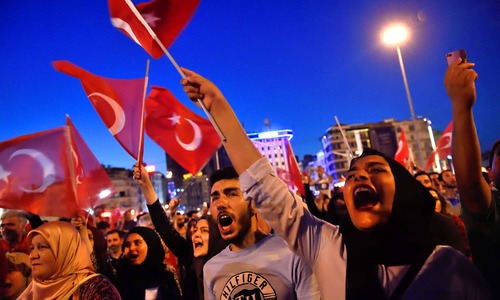
In an address to parliament late on Friday, Erdogan vowed to bring to justice supporters of the Gulenist “terrorist” movement and he urged Turks to continue attending rallies in major cities in support of democracy and against the coup plotters.
More rallies were planned over the weekend in many towns and cities.
In Istanbul, Turkey's commercial capital, authorities have allowed people to travel for free on the metro system so they can more easily attend the rallies. Video screens on trains show pictures of citizens, or “martyrs”, killed in the violence.
Cars and mini-buses honking their horns drive around the streets until late in the night carrying flag-waving supporters of Erdogan shouting patriotic or religious slogans.
On Friday evening Erdogan held his first meeting since the coup with the head of the national intelligence agency, Hakan Fidan, after complaining of significant intelligence shortcomings ahead of the coup attempt. Despite media speculation, however, he did not sack Fidan.
Foreign Minister Mevlut Cavusoglu told private broadcaster NTV that Turkey expected to complete within 10 days a dossier requesting Gulen's extradition from the United States.
Cavusoglu said the link between soldiers involved in the failed coup and Gulen's extensive network of followers was “very clear”, adding that Turkey would do all it could “politically and legally” to secure his extradition.
'Ankara needs to provide clear evidence of Gulen's involvement'
The United States has said Ankara needs to provide clear evidence of Gulen's involvement before it can agree to extradite him. Lawyers say that process could take many years.
After the coup, Western countries pledged support for democracy in Turkey, a NATO ally and an important partner in the fight against Islamic State, but have also expressed concern over the scale of the subsequent purges of state institutions.
Turkish authorities have suspended, detained or placed under investigation more than 60,000 soldiers, police, judges, teachers, civil servants and others in the past week.
Critics of Erdogan in Turkey and abroad fear he is using the failed coup to wage an indiscriminate crackdown on his opponents. They say the purges risk sweeping up innocent people too and that some institutions being shut down may have little or no connection to Gulen's movement.
'Turkey would strongly adhere to democratic principles'
Speaking at a meeting of G-20 finance ministers and central bankers in China on Saturday, Turkish Deputy Prime Minister Mehmet Simsek said Turkey would strongly adhere to democratic principles and the rule of law.
In Ankara, the minister for European Union affairs chided Western countries for not sending any representatives to demonstrate their solidarity with Turks since the coup attempt.
“We are very surprised that our allies have not come to Turkey to visit even after one week has passed,” Omer Celik told reporters.