0
0

IN the struggle against the British imperial forces in the Indian subcontinent, Hosh Mohammad Sheedi and his call “Marveysun marveysun, per Sindh na desun (“We will die but not give Sindh to others”), resonate even today. The phrase has been adopted into popular political discourse and the most marked use is by Pakistan Peoples Party (PPP) chairman Bilawal Bhutto-Zardari in many of his fiery speeches. Ironically, though Hoshu Sheedi is considered a hero among his people, his services to the freedom movement in Sindh have for long escaped public recognition, especially from those who frequent the corridors of power.
Yaqoob Qambrani, president of the Pakistan Sheedi Ittehad, narrated how he brought the famed general’s tale to the attention of the province’s politicians. “Bilawal Bhutto-Zardari usually quotes Hoshu Sheedi’s slogan about Sindh. So one day I decided to tweet to him and inquire whether he knew the background of this quote, and if he had ever visited Hoshu Sheedi’s tomb. He did not know where the mazaar was and neither was he aware of its historical significance.”
So in Oct 2014 Bilawal, on the invitation of Yaqoob, visited the tomb of Hoshu Sheedi which is in Goth Siyal near Hyderabad, and not in Pucca Qila as is popularly believed.
Hoshu Sheedi, belonging to the African-descent Sheedi community of Sindh, is believed to have been born in 1801 and worked at the residence of the Talpurs, rulers of Sindh. It was in the Battle of Dubba (1843) against the British forces who were under the charge of Sir Charles Napier, that Hoshu Sheedi helped solidify the cause of independence of the subcontinent and was hailed a national hero, though having lost his life in the battlefield.
Recognising the services of the general, Bilawal pledged financial support for the conservation of his tomb, which was to be developed into a complex, under the ambit of the culture department. A year and a half later, conservation of the grave of Hoshu Sheedi began recently.
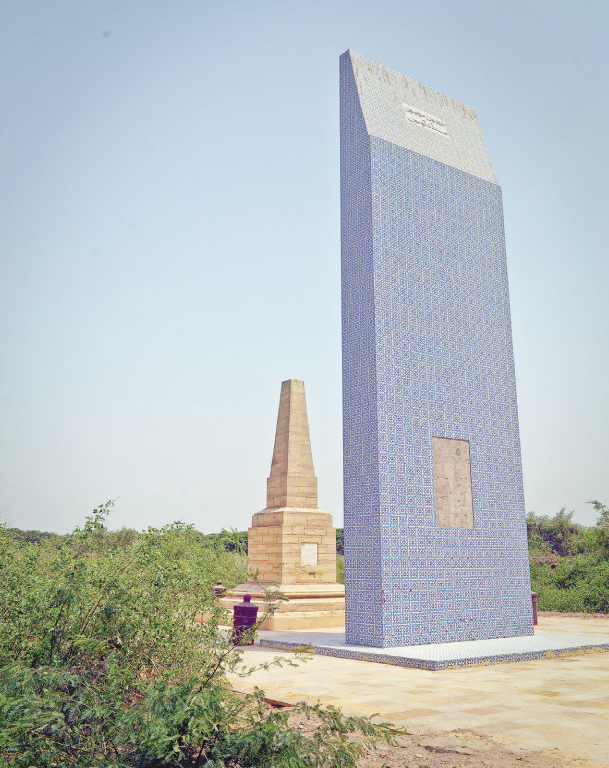
The tomb is located adjacent to a small village which can be accessed through winding roads amid lush picturesque fields. But before we head to Hoshu Sheedi’s tomb, or what’s left of it, we first stop at the monument set up by the British in recognition of their soldiers who fell in the Battle of Dubba. Surrounding the monument are cannons which were reportedly used in the battle, and around which Hoshu Sheedi, his soldiers, as well as the Britishers fell fighting for causes they held dear.
According to Yaqoob, “this monument is placed in the field where the Battle of Dubba took place. Though it now sprouts vegetation, this piece of land is called Dubba which means ‘stagnant water’. This is where the defining battle took place and even after the sacrifices of our men, Sindh eventually fell to the control of the British.”
He also highlighted how a Sheedi mela is celebrated each year on March 23 in remembrance of Hoshu Sheedi.
At a short distance is located Hoshu Sheedi’s tomb, the site of conservation work but in reality it is being built from the ground up with its previous, more conservative structure, razed down to make space for a more modern one. A ditch has been built around the grave, and it is now exposed to the weather and its elements.
The residents of the village quickly produce blueprints detailing the different stages of the construction. A plush complex has been planned, with lush gardens surrounding Hoshu Sheedi’s grave.
Adjacent to the grave is a small, hastily constructed enclosure which upon inspection, turns out to house two rooms, one of which is a storage room for construction materials while the other serves the purpose of a primary school for the village children.
The peeling walls of the classroom are haphazardly covered with posters of alphabet and memorabilia usually found in schools. At one end is a large picture of the founder of the nation, who would have been taken aback at the dilapidated state of the desks and chairs the children study on.
A few residents reveal that the makeshift, crumbling school will be bulldozed to accommodate the extensions of the tomb of Hoshu Sheedi. There are conflicting versions on whether there are plans to rebuild the school. Considering the sizeable grants released for Hoshu Sheedi’s tomb, the school should be rebuilt and a better educational framework provided to the children in the village and beyond.
The call of war has led many to early graves. Faceless and nameless, these men have been blurred from the annals of history and reduced to a statistic or a number, either referred to as survivors or labelled as casualties. However, from among these have arisen those who have achieved immortality, and Hoshu Sheedi is one such name.
Published in Dawn, July 10th, 2016