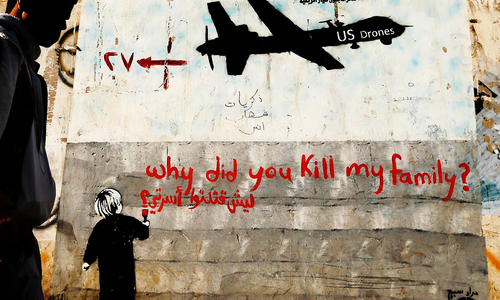
WASHINGTON: The White House released a report on Friday claiming that US drones killed only 64 to 116 civilians in 473 strikes launched between Jan 20, 2009 and Dec 31, 2015.
The drone strikes also killed 2,372 to 2,581 combatants during this period, the White House added.
The report covers strikes only in areas “outside of active hostilities”, which include Pakistan, Yemen, Libya and Somalia. Afghanistan, Iraq and Syria are not covered because they fall in “areas of active hostilities”.
Along with the report, President Barack Obama issued an executive order, requiring annual reporting on civilian deaths in drone strikes and outlining how the administration tries to protect civilians.
Several independent organisations that have been tracking American drone strikes offer higher casualty numbers than disclosed in the report, ranging from at least 200 to 1,000 deaths.
The London-based Bureau of Investigative Journalism has estimated that the drones have killed 492 to 1,100 civilians in Pakistan, Yemen and Somalia since 2002.
“Civilian casualties are a tragic and at times unavoidable consequence of the use of force in situations of armed conflict or in the exercise of a state’s inherent right of self-defence,” Mr Obama said.
“The US government shall maintain and promote best practices that reduce the likelihood of civilian casualties, take appropriate steps when such casualties occur, and draw lessons from our operations to further enhance the protection of civilians,” he added.
The report, however, did not reveal much about the strikes themselves or the people who were killed.
Amnesty International welcomed the executive order, saying that it was a “vital step in the right direction” as it “set a precedent for how future administrations, and other governments, use lethal drone technology”.
But another human rights group, Reprieve, said the report was “a cooked book of numbers … without the names, faces and detail necessary for real accountability to take place”.
White House spokesman Josh Earnest said at a news briefing minutes before the report was released that the executive order would ensure that the counterterrorism strategy President Obama had put in place continued to be transparent and durable in the future.
“The president believes our counterterrorism strategy is more effective and has more credibility when we’re as transparent as possible,” he said. “There are obviously limitations to transparency when it comes to matters as sensitive as this.”
Mr Earnest said that some war zones had been excluded because the Pentagon, which already had a process for disclosing civilian casualties, carried out the drone strikes there. By issuing the report, the administration had created a way to disclose deaths from drone strikes conducted by entities other than the military, he said.
Most of the strikes in Pakistan are conducted by the CIA, which does not disclose details of its operations.
The White House said the Director of National Intelligence had prepared the report.
A White House fact sheet, issued with the report and the executive order, said the measures announced on Friday were meant to “institutionalise and enhance best practices” in US counterterrorism operations and to provide greater transparency and accountability regarding those operations.
The White House said the executive order would apply to all US operations, regardless of where they were conducted.
The order directed relevant US departments and agencies to sustain the measures outlined in the document in all “present and future operations”.
Such measures include conducting training on implementation of best practices that help reduce the likelihood of civilian casualties and dedicating operational resources to mitigate that risk.
The order acknowledges the US government’s responsibility for civilian casualties and offering condolences, including ex gratia payments, to civilians who are injured, or to the families of civilians who are killed.
Published in Dawn, July 2nd, 2016