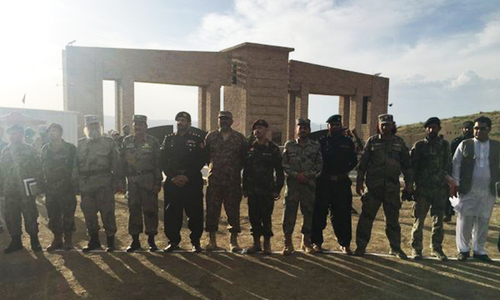
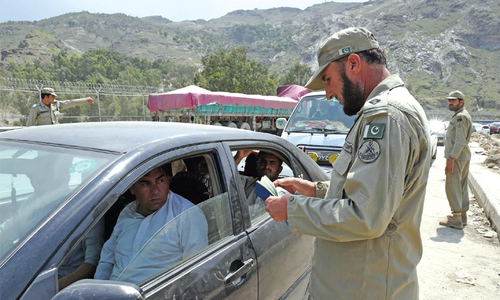
ISLAMABAD: A petition was filed in the Lahore High Court (LHC) against the handing over of Angoor Adda checkpost to the Afghan government, which the petitioner maintained was an offence under section 24 of the Pakistan Army Act (PAA) 1952 which states that delivering any garrison, fortress, airfield, place, post or guard is punishable under PAA.
In his petition, former assistant judge advocate general retired Lt-Col Inamur Rahim requested for the initiation of proceedings against those senior officers who had allowed transferring the control of the said checkpost.
The petitioner has served as a senior instructor at the Pakistan Military Academy in Kakul for over a decade and has remained a Judge Advocate General Branch of Pakistan Army for over 16 years, He cites media reports as saying that the checkpost was handed over “with a view that it would strengthen [Pakistan’s] relations with the Afghan government” and adds that a military spokesperson had also tweeted about the handing over of the checkpost.
On May 23, the petitions says, the interior minister had also “very strongly reacted to the handing over of the checkpost to the Afghan government and expressed serious reservations”.
Petitioner claims the move has rendered thousands of Pakistani homeless, country-less
According to para 6 of the petition, the Angoor Adda checkpost spreads over kilometres where thousands of Pakistanis live. As a result of the handover, the petitioner maintains, those Pakistanis lost their citizenship and have also been made homeless.
It reads: “The decision of military authorities of hand over the post to Afghan government caused serious unrest among the whole nation especially the ex-servicemen therefore the petitioner being convener of ex-servicemen legal forum called emergent meeting and after deliberations unanimously expressed their grave concerns that under which authority the military leadership delivered the post to Afghan government.”
It goes on to say that only parliament can decide bilateral matters with other countries and that the duty of the chief of army staff was to defend Pakistan.
Referring to military interventions in civil matters, the petition says that “[the military] destroyed the sociopolitical structure of our society”.
Also criticising the signing of the Indus Basin Treaty by Field Marshal Ayub Khan, the petitioner maintained that even the federal cabinet and parliament were kept from the treaty, which had been condemned by Fatima Jinnah as well.
The petition pointed out that the Hamoodur Rehman Commission report had pointed out negligence by the military leadership which had resulted in the fall of Dhaka, that military dictator Gen Ziaul Haq had used the military in US-Soviet war and was responsible for the loss of Siachen, that his successor Gen Mirza Aslam Baig used the ISI and MI to ‘bribe’ politicians, that Gen Jahangir Karamat had endorsed the establishment of the National Security Council (NSC) and that Gen Pervez Musharraf had brought the Nato-Afghan war to the country and allowed the US to use the country’s airbases.
The petition claimed that the incumbent army chief Gen Raheel Sharif had improved the army’s image but had consented to the handover of Angoor Adda to the Afghan government which is an act of coram non judice.
The petition cited the prime minister, defence secretary and senior military authorities as respondents and requested LHC to direct the prime minister to initiate proceedings against the officials for handing over Angoor Adda.
The relevant official of the Inter Services Public Relations (ISPR) could not be contacted despite repeated attempts. However, in a statement issued after handing over the post to Afghan government, the ISPR said: “To strengthen the brotherly relations between Pakistan and Afghanistan and with a strategic intent to improve border management, the multi-purpose built crossing facility at Angoor Adda was handed over to the Afghan authorities.”
It said that the gesture would act as catalyst and was envisioned to bring momentum for establishing peace and stability along the Pakistan-Afghanistan border.
“It was reiterated during the process that all border-related issues will be amicably resolved through mutual consultations subsequently,” the ISPR had said.
Published in Dawn, June 7th, 2016