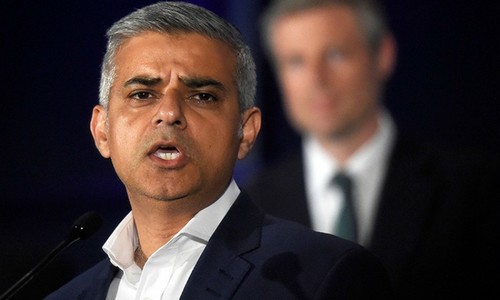
Sadiq Khan is London’s new mayor. Today is his first day in office. Or, as the world’s press would have it, he is London’s first Muslim mayor; the first Muslim mayor of a European capital. As results rolled in on Friday, to show that he had beat the Conservative Party’s Zac Goldsmith 57pc to 43pc, global news headlines began trickling in, with Khan’s religious identity inevitably the adjective of choice.
The New York Times described Khan as “one of the most prominent Muslim politicians in the West”; the American news website Drudge Report went for a cruder option, describing Khan as “the first Muslim mayor of Londonistan”.
The headlines have echoed the tenor of the London mayoral election, which has been a case of identity politics at its worst. The Conservative Party tried to play up Labour candidate Khan’s Muslim identity, casting it in a negative light — even positing it as a threat. A leaflet in Goldsmith’s name was distributed to the homes of voters with Hindu- and Sikh-sounding names, claiming that Khan would impose a wealth tax on family jewellery — simultaneously scaremongering and offending by conjuring stereotypes of South Asians with stashes of gold bangles.
Examine: Europe needs Muslim role models
A letter in Prime Minister David Cameron’s name addressed to similar constituencies described Khan as “dangerous”. Other Conservative materials distributed to the homes of Hindu, Sikh and Tamil Londoners contained assurances that Goldsmith would keep London safe from terrorist attacks (with the implication that Khan would not).
Sadiq Khan’s win has ultimately come down to policies.
Goldsmith and Cameron also repeatedly accused Khan of being sympathetic to extremists, with the prime minister accusing him of links to radical imam Sulaiman Gani (Gani subsequently declared that he voted for the Conservative Party in the last general election).
The Conservative campaign backfired, as confirmed by the election results. Londoners have been offended at being singled out on a linguistic, ethnic and religious basis, and for being treated as communities apart from the British mainstream — some have accused the Conservative party of stoking communalism. Goldsmith’s campaign has been labelled racist and bigoted. Goldsmith’s sister Jemima on Friday tweeted that she was “sad that Zac’s campaign did not reflect who I know him to be”.
Acknowledging the criticism of his rival’s campaign, Khan in his victory speech said he was proud of Londoners for choosing “hope over fear, and unity over division”. With these words, he has offered a strong reminder of the limitations of identity politics.
If Khan were interested in identity politics at any time in this campaign, it was in the context of class not creed. His campaign materials sought to frame the mayoral race as a contest between the son of a bus driver and the son of a billionaire. His official campaign video showed him riding a London bus, recalling his youth spent in a council flat — a form of public housing — while musing London’s current shortage of affordable homes.
But Khan’s victory has ultimately come down to policies: his commitment to ensure that 50pc of new homes built in London are affordable; his promise to freeze public transport fares for four years; his pledge to improve the city’s air quality and help Londoners gain skills to boost employment. His victory has also come down to the perception that Khan is an effective politician. As the local press has pointed out, he doesn’t lose — he’s won seats as an MP and he helped the Labour party increase its vote share in London during the last general election even while the party was decimated elsewhere in the county.
There’s a lesson here for Pakistani politicians, many of whom are probably smugly celebrating the win of a British-Pakistani Muslim mayor (and wondering what his housing policies mean for the value of their Mayfair apartments). When election fever begins in Pakistan, too many parties remain complacent, relying on ethnic and linguistic affiliation to determine who they represent and how they win their votes. The PML-N has tried to reframe itself as a party that tackles the three Es — extremism, energy, economy — but by only doing so in Punjab it continues to implicitly play an identity politics.
In a Pakistan where the effects of the 2010 political devolution have yet to fully manifest, identity politics may seem like a valid option. But if Khan’s victory shows anything, it’s that it offers no guarantees — if anything, it can be the thing that loses an election. This is particularly true in large cities where diverse identities are subsumed by the shared urban experience and the only things that matter are sensible policies and good governance. There are lessons here for politicians in the fastest urbanising country in South Asia; we’ll have to wait until 2018 to see what they have learned, if anything.
The writer is a freelance journalist.
Published in Dawn, May 9th, 2016