ISLAMABAD: The grandson of the last wali of Swat, Adnan Aurangzeb, was invited by the Asian Study Group to make a presentation on the history of Swat, starting from 5,000 years ago to the period between 1917 and 1969.
The session at the Serena Hotel focused on the progress, prosperity and modernity in the region.
It included the installation of Miangul Abdul Wadood as the first wali of Swat in 1926, the relationship of the region with the British government in India, its merger with Pakistan in 1969 and its contributions towards Pakistan.
Mr Aurangzeb was invited to give the presentation after a similar one he gave last year proved to be popular with participants.
“The story of the state is entwined with the story of the family. For generations, prospective heirs eliminated one another till Sir Abdul Wadood came to be the sole claimant to the Akhund and heir to the State,” he said.
The wali had focused on the improvement of the judicial issues, said Adnan Aurangzeb, who has also served as an MNA.
“The basic tier of the judicial system was the qazi and 71 were employed to ensure people had justice at their doorsteps. Before the tribal system, the feudals were the jury, judge and executioner,” he explained.
Last wali’s grandson talks about Swat’s transformation from a tribal society to modern state
The wali had also rid the region of weapons, which Mr Aurangzeb said was no easy task in Pakhtun culture.
“As a result, the number of murders went down by a hundred times to 22 a year. He established law and order but not arbitrarily. He called together a grand jirga in each district, which drew a code of conduct that would apply to their locality and it was according to those codes that they were governed,” Mr Aurangzeb said.
Abdul Wadood has also focused on providing social services to people of the region, including education and health. The first boys school was set up in 1922 and education for boys was made compulsory, Adnan said.
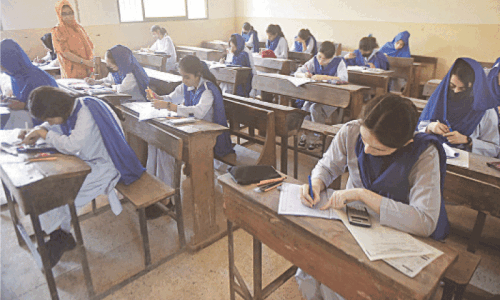
The first girls school followed in 1926 and was made in Saidu Sharif.
“A school for girls was unheard of at the time but he stood his ground and insisted that he wanted an educated population,” Mr Aurangzeb added.
Education was in fact so important that Abdul Wadood’s heir, Miangul Abdul Haq Jahanzeb, established the first college in Swat where classes started in 1954.
The second wali was inspired to build a college after his son went to be educated in Peshawar in what is now Islamia College.
“The college building is still standing, though the Khyber Pakhtunkhwa government is thinking about bringing it down and rebuilding it,” he added.
The improvement of infrastructure was also important to Abdul Wadood, particularly the development of roads, which would link various parts of Swat together. The state was also linked through the telegraph and other communication methods, Mr Aurangzeb said.
The presentation took the audience through the transformation of Swat from a 500-year-old tribal society into an administrative setup governed by law, where justice was ensured and people were provided with social services.
Pictures of the installation of the second wali of Swat by then Prime Minister Liaquat Ali Khan, letters from the Quaid-i-Azam and other memorabilia were also shown, which made the story of the state all the more colourful.
Talking to Dawn after the presentation, Dr Anita Weiss, who is a professor at the University of Oregon and writes about Swat, said: “What is most commendable about the walis is that Swat is the only place that I can think of where the grandmothers are more educated than their granddaughters.”
Published in Dawn, March 23rd, 2016