THE fight against extremism needs to be stepped up — not soon, but now. In an acknowledgement of that urgency, the interior ministry has announced a host of measures to be taken against extremists, many of the steps being designed to prevent terror suspects from organising, communicating, travelling and funding potential terror acts.
While the specific steps mooted may have an impact on the margins and may prevent some individuals from drifting back into the embrace of extremism, the new measures have left some fundamental questions unanswered.
Why, for example, is the state, and the interior ministry in particular, always so eager to boast about any step it dreams up in the fight against militancy, but is always reluctant to identify the specific individuals against whom the measures have been or will be applied?
Often times, the difference between mere public relations and actual, valuable counter-terrorism and counter-extremism measures taken up by the state is difficult to establish.
Both before NAP was mooted and since, the state does not appear interested in genuine transparency. Numbers are frequently offered up, but most are scarcely credible.
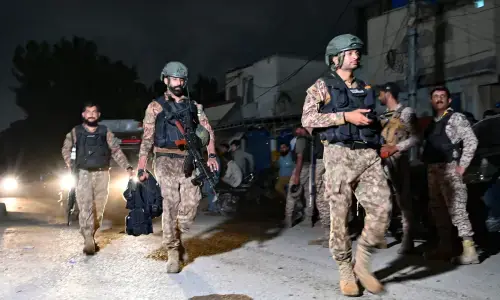
The unprecedented crackdown that the state claims it has conducted on extremists countrywide is allegedly reflected in the tens of thousands of individuals who have been detained by the state.
Yet, those mass detentions do not appear to have spurred mass action in the courts by relatives of the alleged extremists.
Are they ghost numbers that the government frequently reports? Or if the individuals are real, do they belong to extremist networks where it is a settled part of the cat-and-mouse game with the state that occasional arrests and short-term detentions are the price for long-term freedom?
It is perhaps the greatest present-day mystery: an alleged massive, unprecedented crackdown on extremists of every hue nationally has resulted in scarcely a peep from the extremists and their backers.
What is always missing is a basic map of extremism in the country. Which are the groups involved? How are they organised? How are they funded? Who are the leaders? How do the organisational structures cut across provinces and perhaps even the borders of the country?
Nothing has been established publicly, not even a simple, up-to-date list of proscribed groups and the individuals who comprise it. Even where specific measures are announced — such as those by Nisar Ali Khan on Monday — there are questions.
Take a look: Govt to tighten noose around members of banned outfits
Barring individuals affiliated with proscribed groups from having a driving licence or acquiring a SIM is unlikely to prevent those individuals from driving or using mobile phones.
Perhaps the sum of the measures announced previously and on Monday may have some impact on the margins, but extremism is a problem that is beyond the capability of a single ministry — or even a single government, at the centre or in the provinces — to address.
The country may have NAP, but it still lacks national action in a meaningful sense.
Published in Dawn, March 2nd, 2016