Two more Indian students arrested on sedition charges as Amnesty criticises intolerance of dissent


 10
10

NEW DELHI: Two Indian university students have been arrested and face sedition charges after they surrendered following protests in New Delhi where anti-India slogans were allegedly shouted.
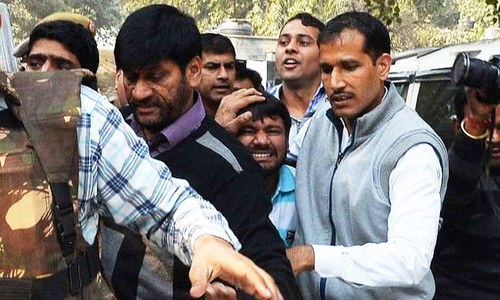
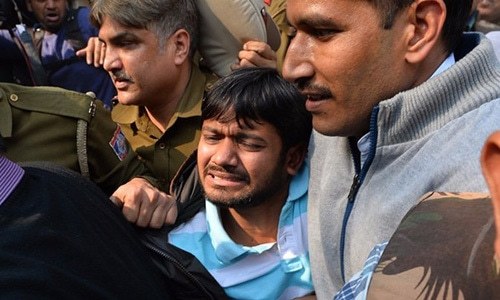
After avoiding arrest for more than a week, the two came out of Jawaharlal Nehru University (JNU) campus late Tuesday and gave themselves up to police.
Rajan Bhagat, New Delhi police spokesman, said the two were questioned and arrested Wednesday. The two deny the charges.
Kanhaiya Kumar, president of the university's student union, was arrested earlier over his participation in events on February 9 when anti-India slogans calling for the destruction of India and independence for the Indian portion of Kashmir were allegedly shouted.
Police are still looking for three other students who have been missing for more than a week.
Amnesty criticises India for intolerance of dissent
Amnesty International has joined a growing international chorus accusing India of supporting a climate of intolerance by cracking down on dissent through arbitrary arrests, caste-based discrimination, extra-judicial killings and attacks on freedom of expression.
The rights group said in its annual international report, published Wednesday, that India's Hindu nationalist government led by Prime Minister Narendra Modi had failed to prevent hundreds of incidents of communal violence, usually involving members of the Hindu majority pitted against Muslims or other minorities.
Instead, ruling party lawmakers and politicians were fuelling religious tensions with provocative speeches and justifications for the violence, it said.
Amnesty's report also highlights the government's continued harassment of civil society groups critical of official policies over the past year, as well as government legal action aimed at controlling foreign funds for non-governmental organisations.
"Over 3,200 people were being held in January under administrative detention on executive orders without charge or trial," the report said, adding that state authorities used "anti-terror" laws to illegally hold activists and protesters in custody.
The report is the latest criticism to be levelled at Modi's government after a year fraught with communal tension as members of India's governing Bharatiya Janata Party try to impose their brand of hyper-nationalism.
Explore: Whatever created the impression that Narendra Modi was a moderate?
Dozens of Indian authors, scientists, historians and film industry workers have returned national awards to protest the trend, which has seen arrests of student protesters, the murder of three atheist scholars and mob killings over rumours of cow slaughter. Among India's majority Hindu population, cows are considered sacred.
Last week, a group of 133 university professors from around the world ─ including linguist Noam Chomsky, Nobel-winning novelist Orphan Pamuk and economist James Galbraith ─ said the recent arrest of a student leader on sedition charges "is further evidence of the present government's deeply authoritarian nature, intolerant of any dissent, setting aside India's long-standing commitment to toleration and plurality of opinion."
Modi and his government have remained largely unmoved by the criticism, saying little in response other than to denounce it as anti-government propaganda designed to distract from the government's agenda.
Meanwhile, Modi has insisted he is prime minister for all of India, and not just Hindus, and urged the nation to instead focus on growing the economy.