0
0

KARACHI, Nov 8: Banks and development finance institutions did retract from the stock market when the equity price bubble burst in September-October, but the pace of their retreat was very slow.
The banks and DFIs reduced their overall exposure in stocks from Rs44 billion as on September 6 to Rs42.2 billion as on October 18, 2003, showing a reduction of Rs1.8 billion or four per cent only.
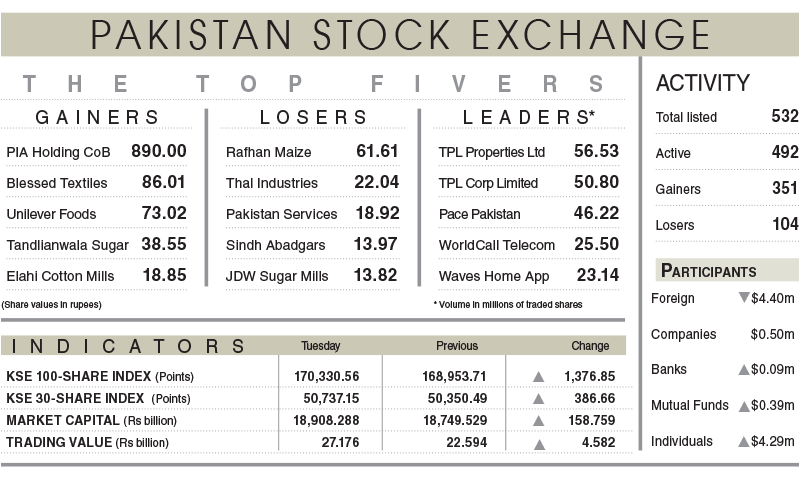
But during this six-week period the Karachi Stock Exchange 100- share index shed 494 points, showing a decline of 11 per cent. The index fell from 4,463 points as on September 5 to 3,969 on September 17. KSE market capitalization also fell 12.7 per cent or by Rs124 billion during this period — from Rs976 billion as on September 5 to Rs852 billion as on October 17.
This seemingly slow withdrawal of the banks and DFIs from the stock market is explained by senior bankers as a sign of growing support the equity market is getting from financial institutions.
“Let me tell you this slow withdrawal shows how supportive we have been to the stock market,” said head of a large local bank, who declined to be named.
But the latest statistics on badla financing by the banks posted on SBP website adds a new dimension to this theory. Total badla or margin financing by the banks and DFIs that stood at Rs10 billion as on September 5 fell to Rs5.3 billion as on September 18 — a decline of Rs4.7 billion or 47 per cent. Why it is so that the banks and DFIs made a very fast downward adjustment in margin financing, but they only slightly reduced their overall exposure in equities? “That shows banks and DFIs were quite cautious in margin financing...but they had an overall positive outlook of the market,” added the top banker.
Top bankers may find it easy to sell this view to the policy markers — and may also earn appreciation from stock market players. But for general public delayed withdrawal of banks and DFIs from the stock market when the market is going down raises a key question. Were the banks doing this to average out their equity pricing — and would it not result in overall depreciation of the value of their equity holding — if the market went further down? In that case banks would be witnessing a loss that would reflect on the returns on bank deposits.
“Worse still is the fact that the Rs42.2 billion exposure of the banks and DFIs as on October 18 was not evenly distributed,” said a source close to the State Bank. He said a high-profile privatized bank and another bank having enough expertise in Islamic banking were among those whose equity holdings were very high.
Some bankers argue that they had to minimise their exposure in badla financing quickly because they knew that the State Bank is in the process of finalizing some restrictions on it. At first this sounds logical because the SBP posted on its website a set of draft rules for margin financing this week — and it said in a press release that it had drafted the rules in consultation with stakeholders. Obviously then the banks being one of the stakeholders must have been aware of the proposed rules — and they thought it wiser to cut exposure in margin financing.
But stock brokers say this was not the case. They say that the banks on the one hand reduced the volume of margin financing and on the other they bought more shares in the declining market to average out the prices of the scrips they held.
Bankers involved in stock market dealing also admit that when the market started going down people, including brokers who had borrowed money from banks to buy shares, offloaded their share holding to retire bank credit.
“So you can say the market went down between September 5 and October 17 on genuine general selling,” admitted a former head of Karachi Stock Exchange, who too declined to be identified. But he said he did not share the perception that it was bursting of equity price bubble. “There was no bubbles in the market. Share prices keep rising and falling. That is a routine,” he said when pointed out that many in the financial sector believe that an equity price bubble had formed on the back of excess liquidity in the banking system with not many avenues open for productive lending.
Even part of the loans acquired by the private sector were used for reinvestment in real estate and stock market rather than in production.