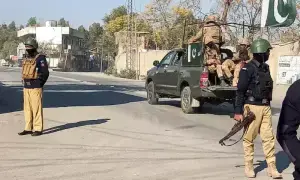
Having pledged to investigate and act on any evidence found or shared on the involvement of Pakistani individuals in the Pathankot attack, the government claims to have detained alleged members of Jaish-e-Mohammad and sealed so-called offices of the banned militant group.
The emphatic language in the statement issued by the Prime Minister’s Office following a meeting of senior civilian and military leaders suggests that the government is attempting to ensure that the foreign secretary talks meant to kick off the Comprehensive Bilateral Dialogue can take place as soon as possible.
Officially scheduled to begin on Jan 15, there is reason to be hopeful that the talks will, in fact, go ahead as planned, or take place after a minor delay.
The initial response from the Indian government to yesterday’s announcement of fresh steps being taken against JeM also suggests that the high-level diplomacy and personal involvement of Prime Minister Nawaz Sharif and the military leadership in the Pakistani response to the Pathankot attack may pay off.
Examine: After Pathankot
Whatever the JeM militants intended to achieve with the Pathankot attack the governments of India and Pakistan appear to have thwarted with their mature responses. But why was the group still able to plan and execute such an audacious and sophisticated attack on the air force base?
The PMO statement offers a clue — “offices of [JeM] are also being traced and sealed” — but it is an inadequate explanation. Thirteen years after the group was banned by the state, why was it able to still operate offices that are only now being sealed?
For too long, militant groups that have been banned by the state have simply changed their names or gone temporarily into hiding, only for them to reappear stronger and more resilient. In the case of JeM, the state’s failures have been exceptionally egregious. Until yesterday, when he was reportedly detained, Masood Azhar was a free man; other well-known leaders of the group apparently routinely roam the country preaching jihad.
It is fairly obvious that leaders of banned outfits publicly exhorting violence is likely to lead to some kind of disaster or crisis. Pathankot has certainly been the former, though mature political leadership on both sides of the border has prevented it from becoming a full-blown crisis.
For the state here, the challenge will be to ensure that the initial actions against JeM are converted into sustained and meaningful measures that ensure the long-term dismantling of militant groups. Too often steps taken in haste have unravelled over time.
To permanently seal offices and successfully prosecute those involved in the Pathankot attack, a great deal of evidence will need to be gathered.
Past experience suggests that JeM, like some other banned organisations, has access to sophisticated legal counsel which can help protect its operations and its leaders’ freedom. This time JeM, and others like it, must be fully and permanently dismantled.
Published in Dawn, January 14th, 2016