0
0

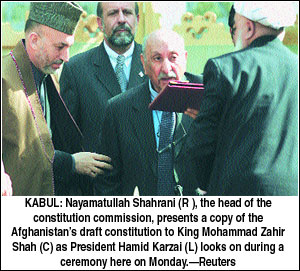 KABUL, Nov 3: Afghanistan’s draft constitution, unveiled on Monday after a two-month delay due to political wrangling, envisages a strong president elected directly by the people and describes the country as an Islamic republic.
The document, which also envisages a bicameral parliament for a country torn apart by decades of violence and controlled in large part by warlords, paves the way for elections in mid-2004 that President Hamid Karzai is expected to contest.
Copies of the draft, which must be formally adopted by a Loya Jirga scheduled for December, were handed to Karzai, former king Mohammad Zahir Shah and UN special envoy to Afghanistan Lakhdar Brahimi at a formal ceremony in Kabul.
“There will be a strong presidential system which will have one vice-president,” Constitution Commission member Shukrya Barikzai told Reuters at the ceremony.
She added that there would be no position of prime minister and that the president would be elected directly by the Afghan people, not by members of parliament.
The draft says the president will nominate 50 per cent of the upper house of parliament, or the “Meshrano Jirga” (House of Elders). The lower chamber will be called the “Wolesi Jirga” (House of People), according to a statement from the commission.
The president will also have the power to dissolve and appoint the cabinet “with consultation with the parliament”.
The commission statement stressed the importance of national unity and a society free from oppression and violence.
More than 350 people, including many rebels, have been killed in the last three months across the country in attacks blamed on remnants of the ousted Taliban, the al Qaeda network and rival factions led by local warlords.
The draft describes Afghanistan as an Islamic republic.
“In Afghanistan, no law contradicting the values of the holy religion of Islam can be enforced,” one section of the document says, making no mention of the strict imposition of Shariat enforced under the Taliban before its ouster two years ago.
The Taliban banned girls from attending school and most women from work, and carried out public executions.
The role of religion has been one of the most sensitive areas in drawing up the draft, with Islamic parties made up of former fighters of the mujahideen (holy warriors) arguing for a more conservative approach than moderates in government like Karzai.
The document allows other religions to practise freely “within the limits of the provisions and values of the constitution...”
The constitution calls on the government to promote the education of women, an attempt to reverse the discrimination against women that was at its worst under the Taliban.—Reuters