4
4


BEIRUT: In the militant Islamic State group's Syrian stronghold of Raqqa, sirens ring out whenever a warplane approaches as jihadists flee their posts and vehicles to hide, activists say.
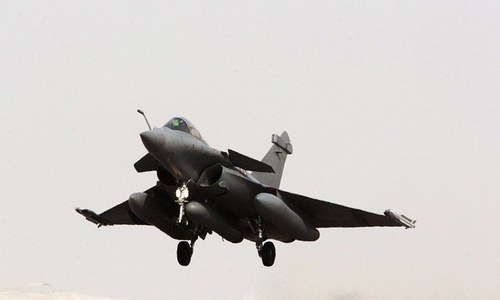
A United States (US)-led coalition and Russia have stepped up air strikes on the jihadists' de facto Syrian capital since IS claimed to have downed a Russian passenger plane over Egypt's Sinai in October and the deadly jihadist attacks in Paris two weeks later.
"The sirens are on the roofs of high buildings, in the squares and in the streets," Taym Ramadan, a city resident and anti-IS activist, told AFP.
"When a warplane enters Raqqa's air space, the sirens ring out to warn IS members," said the activist from the "Raqqa is Being Slaughtered Silently" campaign group.
"As soon as they hear the sirens, they immediately leave their posts," he said.
"Some of them have been seen to leave their vehicles in the middle of the road" to hide.
Read: France bombs IS HQ in Raqqa, hunts attacker who got away
A fellow activist who calls himself Abu Sham al-Raqa added: "Whenever the jets fly over they set off the sirens to warn the fighters and the residents, and the problem is that the bombing is going on night and day."
Raqqa has been under IS control since January 2014 after heavy fighting between the jihadists and opposition fighters, who had seized it from regime control in March 2013.
"Raqqa is Being Slaughtered Silently" has secretly documented IS abuses in the city since April 2014 when it became off-limits for journalists after several were taken hostage and killed.
Tunnels
With more airstrikes, IS has taken further measures to protect its members.
"The group has resorted to tunnels — some previously used and others now being dug out inside the city," Ramadan said.
According to Abu Sham, "The group has moved all its control posts that used to be on the city outskirts to heavily populated residential areas" after some of these were targeted.
On November 15, French fighter jets targeted weapon caches and a training camp on the southern and western outskirts of the city, according to the French army.
Researcher and writer Hisham al-Hashimi said that the group's latest measures included 'moving its stores to residential areas and abandoning its training camps," as well as "depending on tunnels to hold its meetings."
IS "holds its general meetings in hospitals and mosques" as it knows that the coalition and Russia do not target them to avoid killing civilians, he said.
The jihadist group's leaders communicate using "verbal communication in code," he said.
Rami Abdel Rahman, director of the Syrian Observatory for Human Rights (SOHR) monitor, said a large number of IS fighters had been moved from Syria to Iraq.
Also read: Al Qaeda Syria unit executes dozens of rivals in Raqqa
According to Hashimi, IS has stopped transporting its oil products in 36,000-litre tankers and started using smaller, 4,000-litre vehicles after coalition and Russian airstrikes targeted hundreds of fuel trucks in Raqa and Deir Ezzor, where it controls most oil fields.
An investigation by British newspaper The Financial Times last month estimated the jihadists reap some $1.5 million a day from oil, based on the price of $45 a barrel.
Both Moscow and Washington announced this month their determination to increase air strikes on oil infrastructure in IS-controlled areas of Syria.
'Little freedom'
IS has recently upped surveillance of Raqa residents, increasing checkpoints in the city where its members check people's IDs.
According to Abu Sham, its members also carry out night raids on Internet cafes.
IS "has sent out spies to find out who uses the Internet" in these cafes, said Hashimi.
According to the Observatory, IS closed at least 10 Internet cafes last week, but allowed others to open on Wednesday on the condition that they be on a main road, be guarded by two IS members from the area and observe segregation between the sexes.
Internet has been cut from homes and shops for months, with connection limited to the cafes.
Activists say that IS asks all cafe owners to keep them informed with details of their customers.
IS also forbids anyone leaving Raqa to areas not under its control without a "previous permission", Hashimi said.
Since taking Raqa, the jihadist group has spread fear among inhabitants with its brutal executions and punishment of anyone who opposes it and its rulings.
But Hashimi said some trials and executions have been postponed with the increase of air strikes.
Activists agreed that "the religious police has lessened their activity," which has allowed residents to enjoy "time-out" to breathe a little.
"Civilians — especially women — make the best of their absence to enjoy a little freedom, with a young woman for example now able to open a window or go out onto the balcony without a face veil," Ramadan said.