0
0


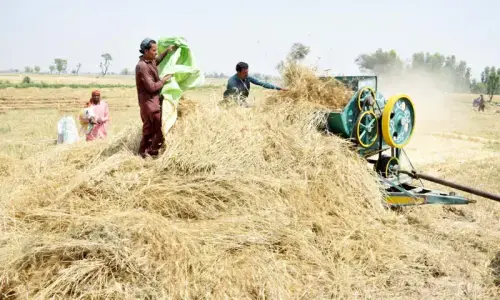
FARM extension services are the main source of disseminating agricultural information among the country’s farming communities. These are mostly provided through face-to-face interactions, but the ratio of agriculture extension agents to growers is very low in Sindh.
In a survey of 764 rural households conducted as part of the Australia-Pakistan Agriculture Sector Linkages Programme (ASLP2), the Social Research Project of the University of Canberra found that 76pc of the households owned mobile phones but they were not using it for getting agricultural information on a regular basis.
When they were asked about their preferred way of getting information through mobile phones, they said they were interested in voice messaging services. Many farming communities were also interested in text messaging.
The three of us developed a mobile phone Interactive Voice Response (IVR) and text messaging service that gives farmers in Sindh access to the required agricultural extension information. We researched a range of ICT options before developing combo services, Farmphone and FarmSMS.
Through the mobile phone-based ASLP2 project, Sindh is disseminating information
to farmers in Mirpurkhas and Sujawal districts in order to improve their knowledge about modern farm technology
Farmphone is based on the Freedom Fone software through which agricultural information is recorded as audio content. This software is organised in multiple voice menus that farmers can access through their phones’ keypad. This system works seamlessly across different devices and different phone networks and is particular well suited for users with low levels of literacy.
In addition to listening to the information, the farmers can leave a message for the agriculture extension officer, ask a specific question, or request an on-site visit.
Farmphone is the ASLP2 information system that uses the Freedom Fone software (http://freedomfone.org). Freedom Fone is free and open source software that enables users to create and share audio content using IVR, voicemail and SMS. Farmers can use it to access production and marketing information.
A social research team organised awareness workshops in various communities and demonstrated the uses of the two models. Farmers, particularly youngsters and children groups, were motivated and trained to use them to share information.
The farmers can communicate and receive information in Sindhi language about various subjects, like dairy, mangoes, kitchen gardening and community service centres. A mobile network number was shared with farmers in the focal and satellite villages so that they could send and receive modern extension services without any hassle.
FarmSMS is a free SMS-based software and provides a range of individual and group text messaging options in different languages. The software turns a laptop or a mobile phone or modem into a central communications hub and enables users to send and receive text messages with large groups of people. It also enables instantaneous two-way communication on a large scale.
Through this mobile phone-based ASLP2 project, Sindh is disseminating information to farmers in Mirpurkhas and Sujawal districts in order to improve their knowledge and livelihoods.
These models were recently demonstrated in a workshop by one of the writers to a group of 58 agriculture extension agents, agriculture researchers, policymakers and government managers from 14 districts of the province.
Over 90pc of the participants believed that these services are highly promising and fill the information gap between the agriculture extension agents and farmers. To assess their impact, a research study conducted by the ASLP-2 found that the software models reduced a range of costs, including travelling and time, as well as service charges incurred by, for instance, livestock farmers when they went to get services from dairy doctors.
The research also highlighted the fact that effective and efficient extension and education services improve farmers’ awareness and knowledge about new farm technologies and translate into improved agricultural productivity.
Prof. Robert Fitzgerald is associated with the University of Canberra, Australia, Dr Tehmina Mangan is associated with the Sindh Agriculture University, Tandojam and Mustafa Nangraj is Assistant Publicity Officer, Agriculture Extension, Sindh.
Published in Dawn, Business & Finance weekly, November 16th, 2015