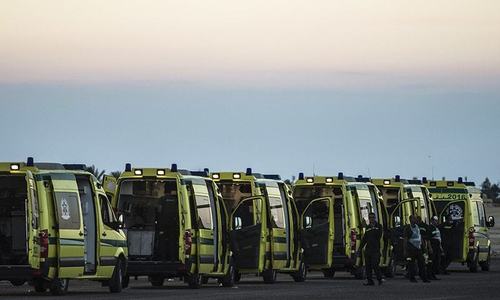
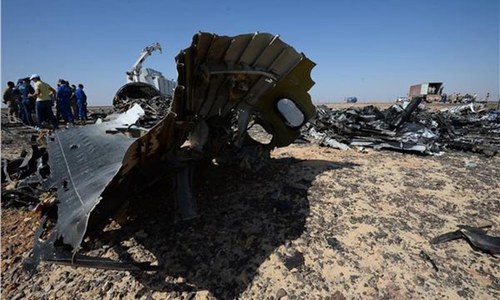
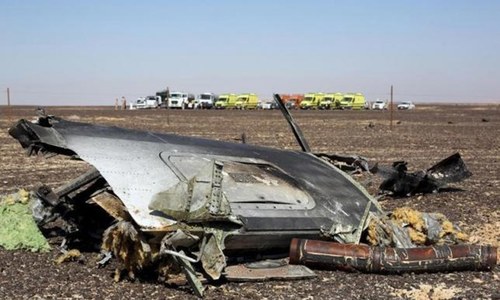
EL-ARISH: Giant posters of Egyptian President Abdel Fattah al-Sisi in military uniform hang at security checkpoints leading to the Sinai, but the crash of a Russian airliner in the peninsula has shattered the image of control they seek to project.
Western officials have raised the possibility that the same militants that are fighting to topple Sisi’s government may have brought down the passenger airplane with a bomb.
Whatever the case, the death of 224 mostly Russian tourists has raised tough questions about the wisdom of Sisi’s approach to militants.
Sisi has justified his goal of crushing every last militant by describing Islamist radicals as a threat to Arab and Western powers which pump billions of dollars into Egypt every year.
Ignoring lessons of the past, Sisi believes wiping out, jailing and sentencing Islamists to death will stabilise Egypt. But the suspicions that the self-styled Islamic State militants may have planted an explosive device on Airbus A321 suggest his strategy may backfire by creating more radicals.
The plane was likely brought down by a bomb, US and British governments said on Thursday. On Friday even Russia, which had called such conclusions premature, suspended its flights to Egypt.
In early September the Egyptian military launched what it called a comprehensive operation dubbed Martyr’s Right. More than 500 people the military identified as militants were killed in the first two weeks alone.
Residents of the Sinai say such high death rates include civilians and have encouraged some young men to take up arms against the state and those who don’t harbour resentment.
“Sisi is waging war against us. He says he is fighting terrorism, but old women and children are not terrorists,” said one elderly woman, sitting in her desert shack made of wood and straw in El-Arish, North Sinai’s provincial capital.
She was forced to live in grim conditions after escaping fighting in her old village, where her mother-in-law was killed.
“She was inside her house when bullets went through the wall and killed her. The soldiers did not even take her to hospital. They went inside, saw she was dead, so they covered her body and just left,” she said.
A security official who asked not to be named denied allegations that heavy-handed tactics by the army cause civilian deaths.
Textbook case
Even as Red Sea holiday resorts in southern Sinai have remained packed with European tourists, the northern part of the peninsula has been under effective army control.
The areas with the worst fighting — El-Arish and the towns of Sheikh Zuweid and Rafah, which border the Palestinian Gaza Strip ruled by the Islamist group Hamas — have been under a state of emergency with a curfew in place for over a year.
The military publishes lists of dead “terrorists” and photos of bodies almost daily, to show Egypt is winning the war against militancy.
Diplomats say Sisi’s hard-line tactics may only generate short-term solutions. Long-term stability can only come with investment and job creation in the Sinai, where residents have long complained of neglect by the state.
“Their goal is to contain the problem now. They want quick results, their strategy will not provide a fix for the long-term,” said one Western diplomat in Cairo.
Residents who spoke on condition of anonymity out of fear of reprisal from both militants and the army told Reuters official militant death tolls often include civilians and that many of those deaths go unreported.
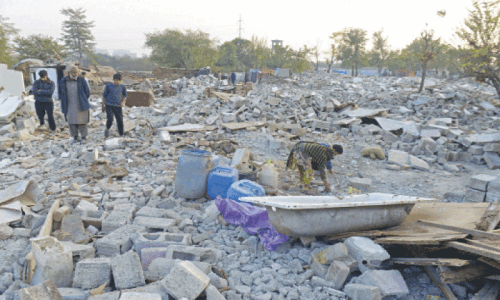
The military forcefully evicted about 3,200 families in the Sinai over the past two years, Human Rights Watch said in a September report.
“Destroying homes, neighbourhoods and livelihoods is a textbook example of how to lose a counter-insurgency campaign,” said Sarah Leah Whitson, its Middle East and North Africa director.
Sisi’s hard line towards militants has paved his path to power since 2013, when as army chief he toppled President Mohammed Mursi. He then launched the fiercest crackdown on Islamists in Egypt’s history. Sisi, who has since won his own election to the presidency, has branded the Brotherhood a terrorist movement and says it is just as dangerous as IS militants and their sympathisers in the Sinai.
Many Western security experts say that prevents authorities from devising the kind of nuanced strategies needed to stabilise Egypt, the most populous Arab country.
“Sisi’s approach to counterterrorism is almost a textbook case of what not to do,” said Daniel Byman, a counterterrorism expert at the Brookings Institution.
They want the dragon slain
IS’s Egypt branch, Sinai province, now consists of hundreds of militants scattered into secretive groups of five to seven men which are hard to track, Egyptian intelligence officials say.
Mohannad Sabry, author of a new book, Sinai: Egypt’s Linchpin, Gaza’s Lifeline, Israel’s Nightmare, said that the longer the government pursues its fierce counterterrorism campaign in Sinai, the greater the danger that it will lose control of the strategic peninsula.
He described a friend’s village in Sinai where the military had razed most of the 60 homes. There were three militants in the village three years ago, now there are around 40, he said.
Francis J. Ricciardone, who served as the US ambassador to Egypt from 2005 to 2008, said that many Egyptians support the Sisi government’s anti-terrorism campaign. “Egyptians understandably are frightened and so tend to see ‘the enemy’ as a single agglomeration of internal and external forces, all the more terrifying and sinister for its polymorphism,” Ricciardone said in an email. “Thus they want that dragon definitively slain, with a ferocity and relentlessness at least equal to the enemy’s.”
If the airplane crash was caused by a bomb, Sisi may use that to justify even tougher measures against militants, the Egyptian state’s most dangerous and resilient foes for decades.
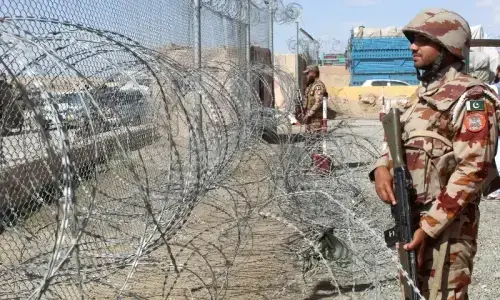
Checkpoints leading to El-Arish are manned by soldiers brandishing assault rifles. Cars passing along a road cutting through coarse desert are thoroughly checked.
There would always be more militants, one Sheikh Zuweid activist said: “It is normal that anyone who has their house torn down or their family killed will try to join militant groups.” For now, as Russia, Western powers and Egypt scramble to determine the cause of the crash, Sinai residents can only wonder if the fighting will escalate.
Many hang Egyptian flags on their rooftops, hoping that will prevent fighters planes from bombing their homes.—Reuters
Published in Dawn, November 8th, 2015
On a mobile phone? Get the Dawn Mobile App: Apple Store | Google Play