5
5
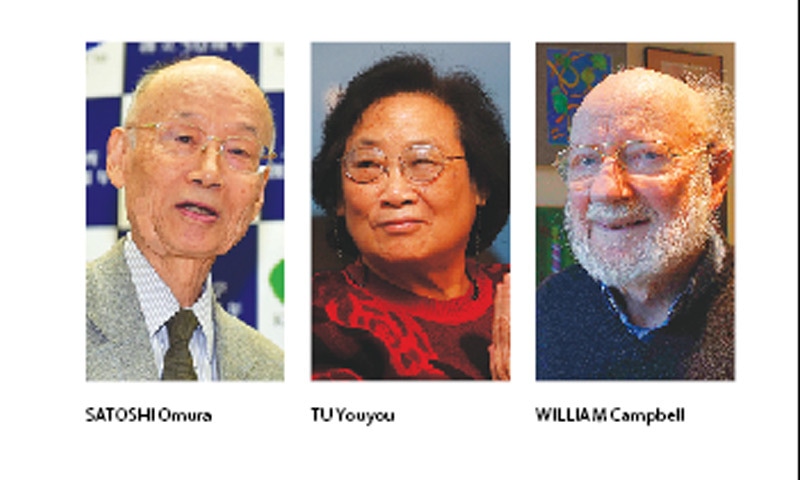

STOCKHOLM: Three scientists from Japan, China and Ireland whose discoveries led to the development of potent new drugs against parasitic diseases, including malaria and elephantiasis, won the Nobel Prize for Medicine on Monday.
Irish-born William Campbell and Japan’s Satoshi Omura won half of the prize for discovering avermectin, a derivative of which has been used to treat hundreds of millions of people with river blindness and lymphatic filariasis, or elephantiasis.
China’s Tu Youyou was awarded the other half of the prize for discovering artemisinin, a drug that has slashed malaria deaths and has become the mainstay of fighting the mosquito-borne disease. She is China’s first Nobel laureate in medicine.
Some 3.4 billion people, most of them living in poor countries, are at risk of contracting the three parasitic diseases.
“These two discoveries have provided humankind with powerful new means to combat these debilitating diseases that affect hundreds of millions of people annually,” the Nobel Assembly at Sweden’s Karolinska Institute said.
“The consequences in terms of improved human health and reduced suffering are immeasurable.”
Today, the medicine ivermectin, a derivative of avermectin made by Merck & Co, is used worldwide to fight roundworm parasites, while artemisinin-based drugs from firms including Novartis and Sanofi are the main weapons against malaria.
Omura and Campbell made their breakthrough in fighting parasitic worms, or helminths, after studying compounds from soil bacteria. That led to the discovery of avermectin, which was then further modified into ivermectin.
The treatment is so successful that river blindness and lymphatic filariasis are now on the verge of being eradicated.
Omura, 80, said the real credit for the achievement should go to the ingenuity of the Streptomyces bacteria, whose naturally occurring chemicals were so effective at killing off parasites.
“I really wonder if I deserve this,” he said after learning he had won the prize. “I have done all my work depending on microbes and learning from them, so I think the microbes might almost deserve it more than I do.” Omura is professor emeritus at Kitasato University in Japan, while Campbell is a research fellow emeritus at Drew University in Madison, New Jersey.
“This was the work of a team of researchers so it is by no means my work, it’s our work,” said Campbell, 85, who learned of his prize in a pre-dawn phone call at his home in North Andover, Massachusetts.
“In the first decade, there were 70 authors that I co-authored papers with. That gives you some idea of the number of people involved,” he said.
TRADITIONAL CHINESE MEDICINE: Tu, meanwhile, turned to a traditional Chinese herbal medicine in her hunt for a better malaria treatment, following the declining success of the older drugs chloroquine and quinine.
She found that an extract from the plant Artemisia annua was sometimes effective but the results were inconsistent, so she went back to ancient literature, including a recipe from AD 350, in the search for clues.
This eventually led to the isolation of artemisinin, a new class of anti-malaria drug, which was available in China before it reached the West. Tu, 84, has worked at the China Academy of Traditional Chinese Medicine since 1965.
World Health Organisation spokesman Gregory Hartl said the award of a Nobel prize for the discovery was a great tribute to the contribution of Chinese science in fighting malaria.
“We now have drugs that kill these parasites very early in their life-cycle,” said Juleen Zierath, chair of the Nobel Committee. “They not only kill these parasites but they stop these infections from spreading.”
Death rates from malaria have plunged 60 per cent in the past 15 years, although the disease still kills around half a million people a year, the vast majority of them babies and young children in the poorest parts of Africa.
The 8 million Swedish crowns ($960,000) medicine prize is the first of the Nobel prizes awarded each year. Prizes for achievements in science, literature and peace were first awarded in 1901 in accordance with the will of dynamite inventor and businessman Alfred Nobel.
Published in Dawn, October 6th , 2015
On a mobile phone? Get the Dawn Mobile App: Apple Store | Google Play