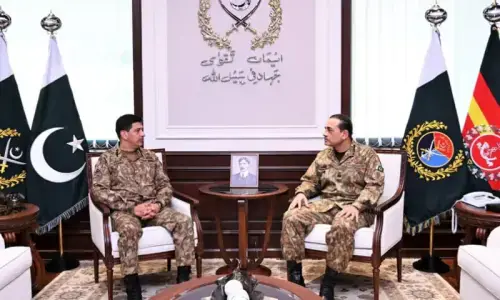
IT seems that our infatuation with ‘saviours’ in uniform remains unwavering, even after the uniform has long been set aside. So it is with retired Gen Pervez Musharraf who has been holding forth on several forums and, in the process, burnishing the argument for the military’s apparently ‘reluctant-but-necessary’ foray into politics. Delivering a talk in Karachi titled ‘Pakistan’s past, present and future’, the former president spoke of how during his own tenure he had refrained from imposing martial law and instead introduced a civilian-run system watched over by the military so that civilians could be prodded to deliver; “there are no angels in Pakistan,” he said.
It is regrettable that our military has yet to realise that its hand on the wheel, both overt and otherwise, can only take the ship of state off-course. Each khaki intervention — invariably on the pretext of ‘saving the country’ — has progressively undermined political institutions to a point where civilian misrule has become a self-fulfilling prophecy, and the denunciation of the democratic system a national pastime. The unvarnished truth is that democracy has never been allowed to take root in this country; elections have been manipulated and governments destabilised; and many of the so-called political mafias have flourished with the encouragement of the establishment that has used them for its own cynical purposes. There are indeed no ‘angels’ in this country, as Mr Musharraf pointed out — but that is not only true of the civilians. At the same time, it must be said that the political class has contributed in full measure to its own degradation by its flagrant disregard for the needs and aspirations of the people. Moreover, the judiciary — the upholders of the law and Constitution — has more often than not through Pakistan’s history, given legal cover to interruptions in the democratic process instead of strengthening its institutional underpinnings. Lastly, the media — divided and corporatised — has also taken the path of least resistance instead of exploring the long-term, corrosive effects of military ‘oversight’.
Published in Dawn, October 4th, 2015
On a mobile phone? Get the Dawn Mobile App: Apple Store | Google Play