0
0

LAHORE, Dec 24: The Punjab cabinet decided on Monday to separate the investigation functions of the police from the watch and ward and maintenance of law and order duties in the first phase of police reforms in the province.
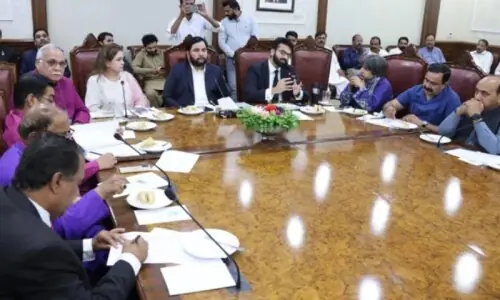
Governor Khalid Maqbool presided over the cabinet meeting which also decided to launch the water ways desiltation campaign from next week and hire 4,109 doctors by the end of February.
The cabinet allocated Rs300 million to implement the first phase of the reforms and build capacity of the police department. The cabinet would constantly review and monitor implementation of the reforms.
Briefing reporters, DIG (headquarters) Tariq Khosa said the decision had been taken to provide relief to people by improving the quality of crime investigation, detection, prevention, and the environment of the police stations.
He said investigation officers in the ranks of sub-inspector or assistant sub-inspector would be posted from the next month at each police station in the province.
Each investigation officer would handle 50 cases and would work under a DSP-investigation (in the smaller districts) and an SP-investigation (in the bigger cities).
Some 800 posts have been sanctioned by the cabinet for appointment of investigation officers at the police stations in 34 districts.
Similarly, specialized squads to investigate organized crime like robberies, thefts, dacoities, etc would work at the districts under the DSP/SP (investigation).
Khosa said the investigation officers would perform no other duties and would be accessible to the public. He said the transfer of investigation of cases would be discouraged to avoid delays in their completion.
The performance of all investigation officers would be strictly monitor to keep a check on them.
He said that the cabinet had also approved reorganization of the Lahore police. The separation of investigation from the other duties would be focussed and stressed here too, and a post of SSP (investigation) had been created for this purpose.
Khosa said the police would rely more on the circumstantial evidence, forensic science laboratories, chemical analysis, etc in their investigation of crime.
He said the investigation officers would also be imparted modern training to improve their skills to detect crime. The training courses would be run both at the district and the provincial level under the directorate of training. The directorate would work under the DIG (training).
He said an intelligence school would also be set up at the provincial level to improve the police intelligence system for prevention and detection of crime. He said military and foreign experts in intelligence would be invited for training the officials.
He said the method of registering FIRs would also be improved and women would be posted at each police station to check crime against women and children as part of reforms.
He said media campaigns would be launched against 10 most wanted terrorists and criminals in each district of the province.
Khosa said the government had also allocated Rs300 million for creating highway police on the pattern of the Motorway police. He said the programme would be implemented in phases. In the first phase checkposts would be set up on busier highways in Lahore, Faisalabad and Gujranwala.
He said the cabinet had directed the police to formulate a strategy to effectively curb terrorism, and control violent and organized crime like murders, robberies, car theft.
He said the IG police and the provincial home secretary had been asked to form a strategy to make the deweaponization campaign effective. He said the local elected representatives may be made responsible for gathering information about illegal arms in their areas.
Besides, he said, the cabinet also underlined the need for checking road accidents, and improve the criminal intelligence system the and law and order situation. He said the police had also been asked to improve its public image and training.
HEALTH: The cabinet also decided to lift the ban on recruitment of doctors placed in 1997 and fill the 4,109 vacancies of doctors in the general cadre at the basic health units (BHUs), dispensaries, rural health centres and tehsil headquarter hospitals through contract appointments for five years.
Briefing newsmen, provincial health secretary Hasan Waseem Afzal The recruitment would be completed through district recruitment committees in a transparent manner by the end of February.
He said each five-member recruitment committee would be headed by the DCO and have the EDO (health), DHQ hospital medical superintendent and one representative each of the district Nazim and the army monitoring team.
He said the recruitment would be “post-specific and nontransferable”.
He said the doctors would get Rs12,000 per month. He said the terms of conditions of the contract would be finalized in 15 days.
The secretary said the filling up of the vacancies would cost the province about Rs524 million. He said the districts had been made responsible for paying salaries of four paramedics — lady health visitor, dispenser, midwife and watchman — at each BHU.
He said on an average each district would have to generate Rs14 million per annum for the payment of salaries to the paramedics. He said the recruitments would create an economic impact of Rs6 billion.
DESILTATION: The cabinet also decided to start desiltation of 2,538-mile long canals in the province from the next week.
Briefing newsmen, irrigation secretary Javed Majeed said some 5,037 channels would be desilted during the campaign to be carried out by the department with the help of 20,000 farmers.
The campaign would cost the government a sum of Rs20 million and would be monitored by the army teams.
Canals throughout the province would be closed from December 26.
The campaign would involve 21,000 farmers, 6,000 trucks and 220 bulldozers.
The secretary said that the desiltation campaign has been organized since 1992 to ensure provision of water to the tail-ends.
He said that the country had been facing water shortage for the last three years. “The Punjab faces shortage up to the tune of 51 per cent this year.” he said.
Information Secretary Kamran Lashari who was also present at the briefing said the cabinet appreciated the role extended by the army during last year’s desiltation campaign.