8
8

MENTION of a police robot brings to mind the television series and movies about a machine that is supposed to protect the innocent while upholding the law but either develops human feelings and emotions, or goes berserk.
“What happens in movies, when is that ever true?” laughs Inspector Kashif Jalal, chief of Karachi’s Bomb Disposal Squad (BDS). “Besides, this little one is totally in our control,” he adds as he introduces me to the anti-IED (improvised explosive device) robot that first made its appearance and caught everyone’s imagination during the Yaum-i-Ali procession earlier this month.
Know more: A young student’s idea of ‘future machine’
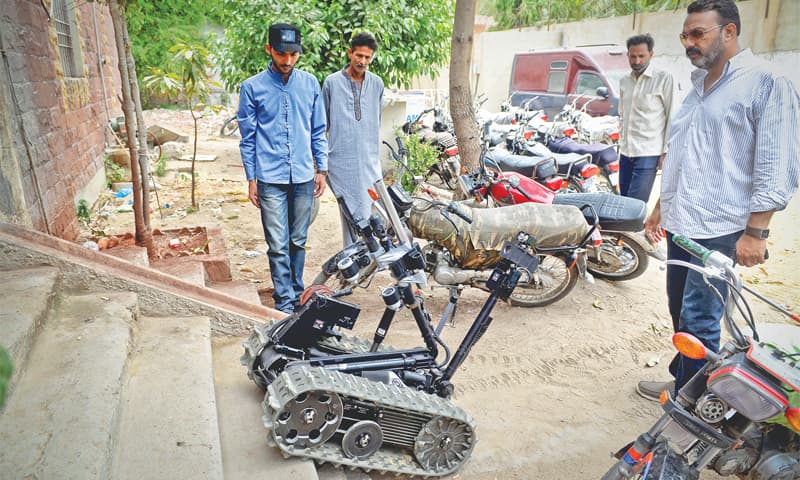
The media carried several reports about it, then. Children wanted their picture taken with it, this seemingly harmless robot. It might be cute, moving on thick rubber tracks that enable it to traverse any kind of terrain (including stairs), but shouldn’t be taken lightly. “It is supposed to look friendly,” suggests Inspector Jalal. “It shouldn’t be scaring people by its appearance while carrying out its job. Think of it as a land drone.”
Equipped with thermal and infrared cameras, a variety of sensors, signal jammers, extendable robotic limbs and a gun, which comes with a selection of barrels, this machine can transmit its findings back to an operator who may be a kilometre away. When fully charged, its battery gives it 10 hours’ life, and it also has a long power cord. And running on a different frequency or special signal, it cannot be picked up on the radar.
The robot, weighing approximately 50kg, comes with its own fully-equipped explosive ordinance device (EOD) vehicle. When it searches out or finds an IED or bomb, it has the capability of destroying its circuits using jammers, a water gun, or by simply firing at it. “And if the bomb goes off, as in the case of mines or booby traps that explode at the slightest touch, it can itself withstand the shockwaves,” explains Inspector Jalal. “And even if it can’t, no lives are lost.
“Earlier, we used to rely on our K-9 unit,” the officer continues. “We still use them, of course, but while a dog may detect a bomb, it cannot defuse it. That’s where we, the human resource, came in. And quite frankly, we only have prayers to keep us from getting blown up. Our kits or the thick suits that we wear, all our equipment, can’t necessarily save lives during an explosion. Some 10 to 15 BDS personnel have been martyred in the line of duty.
“Apart from us, the lives of innocent people would also be at risk. In the West, when told to evacuate, people follow instructions; but here, when we ask people to move away while defusing bombs, the opposite happens and more crowds gather to see what is going on. The anti-IED robot, upon finding a bomb, can pick it up and remove it. In the process, even if it is destroyed itself, at least no lives are lost,” says Inspector Jalal.
Made available to the Karachi BDS through a donation from the UK, the robot costs around Rs10 million. “But human life is invaluable,” Inspector Jalal points out. “We need at least five such anti-IED robots to cover the city. Sadly, the BDS is not perceived as a ‘profitable’ department, so it is often bypassed when budgets are being discussed.”
Inspector Jalal has received special training from the British Army and Federal Bureau of Investigation in the US in handling such technology. He leads a team of three to four men to maintain the equipment. “Bomb disposal is the job of the police in Sindh, Balochistan and Khyber Pakhtunkhwa, but in Punjab it is handled by the Department of Civil Defence,” he tells me. “The first such robots were acquired by Khyber Pakhtunkhwa in 2012. Now there is talk of getting one for Balochistan, which needs it badly. Later, it is also hoped that the Pakistan Railways will have one for checking the railway tracks for IEDs.”
I mention that the robot, for being such a sophisticated machine, has a very unimaginative name. “What would you suggest we call it?” Inspector Jalal grins. “It is our eyes, ears and hands. Since we control it, we give it the name of whoever is controlling it at the time.”
Glancing at the robot placed next to the officer’s desk, one cannot help but smile at its set of lights that look like eyes, though. It’s almost possible to see an uncanny glint in them!
Published in Dawn, July 31st, 2015
On a mobile phone? Get the Dawn Mobile App: Apple Store | Google Play