 |
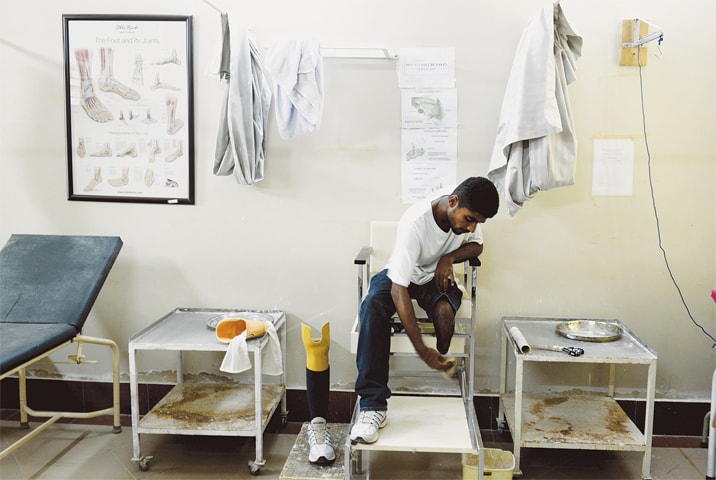
| Getting an artificial limb made is a process that involves a patient, a doctor and an engineer. Some minor tweaks often need to be made before patients are sent home -Photos by Tahir Jamal / White Star |
Twenty minutes had already gone by since the power cut recurred on a hot, muggy Karachi afternoon. Wiping the sweat trickling down his temple, 42-year-old Mirza Zakir Baig fought with what seemed to be a radiator fan issue with the generator that he had to fix before the factory manager yelled over production time loss. He fiddled with an errant wire, a connection sparked and the fan moved. And then it was agonising pain that took over everything else.
“In just 16 seconds my right hand was destroyed forever,” he recalls the 2007 incident, when he lost his right hand. Eight years later, Zakir, a soft spoken man now works as a receptionist at the Institute of Physical Medicine and Rehabilitation (IPMR), Karachi, which provided him not only with an artificial limb but also a job. He lives in Orangi and has two school-going daughters.
In a similar twist of fate, Fakhar Sheikh, 39, was crushed by a speeding tanker on the pavement in Orangi, where he waited for the bus to take him to work at a real estate firm. He was lucky to have survived but lost a leg. Presently, he too works at IPMR, handling the photocopier; a job that enables him to arrive to work on his motorcycle and to look after his four children.
Those who lose their limbs in accidents or disease don’t become pariahs overnight ... Dr Nabila Soomro of the Institute of Physical Medicine and Rehabilitation (IPMR), Karachi, argues it is high time society gives them a chance to live
“There are thousands of success stories,” says Dr Nabila Soomro, who heads the IPMR. “People who have been amputated here or have had new limbs made, all lost their jobs. We have provided jobs to many patients as it is important to absorb them back into society with dignity. We do not use the words disability, impairment or handicap; anymore. Instead, we use the word functional limitation.”
Soomro argues that there is a need to change society’s mindset about the functionally limited.
 |
| Photos by Tahir Jamal / White Star |
“In our society, we just put a little money in their hands, rip off their dignity and send them out to face the adverse. If they cannot do the same kind of work anymore because of the amputation, workplaces should hire them in a new capacity,” she argues.
Affiliated with the Dow University of Health Sciences (DUHS), the institute was envisioned by Prof. Masood Hameed, the incumbent vice-chancellor, and is the first civilian interdisciplinary institute to rehabilitate all kinds of functional limitations. “There was just one proper functional institution of rehabilitation medicine, of the armed forces but it catered to the needs of the Army. No civilian facility existed until the development of this one in Karachi,” says Soomro.
India has over 50 such institutions and even Bangladesh has over 30. What makes this institution unique is that it is multi-disciplinary and offers services in six disciplines such as physiotherapy, occupational therapy, prosthetics and orthotics, centre for child development, neuropsychology, and speech therapy — all under one roof.
“Our data shows that there are way more diabetic patients than bomb blast victims, most of them being men over 50, more urban than rural. From the rural areas of Sindh, we get children and women from accidents on the chara-cutting machine.
About 150 trained and qualified professionals working at the institute include physiotherapists, occupational therapists, orthotists, prosthetists, vocational therapists, speech pathologists, social workers and special educationists.
 |
| Photos by Tahir Jamal / White Star |
The prosthetics and orthotics department provides teaching and training facilities for the students who are taught how to take measurements, how to design, fabricate and make different orthosis and prosthesis. Once they are fully trained, they get to work with patients under qualified supervision.
Discussing the situations where artificial limbs are required, Soomro says there are an increasing number of patients who need amputation rehab services due to trauma, road accidents, bomb blasts and also due to an alarming increase in diabetes.
“During the time when bomb blasts were an everyday occurrence, patients frequently came in with broken limbs, burns and gangrene due to shells or shrapnel. But the major brunt is diabetic amputation and road-traffic accidents,” says the doctor. “Our data shows that there are way more diabetic patients than bomb blast victims, most of them being men over 50, more urban than rural. Diabetes, a disease that is preventable often leads to amputation of a lower limb. From the rural areas of Sindh, we get children and women from accidents on the chara-cutting machine.”
Till date, some 5,000 patients have arrived at the institute for prosthesis and orthosis needs since its inception in 2007. “It takes three to four weeks for an artificial limb to be made. To begin with, measurements are taken and the cast is made after which fabrication is done and the skin colour is matched. Finally the joint is attached. It takes another two weeks for gait training and functional training of the upper limbs. When the patients can function independently, they are sent home, but are instructed to come back if they have any complaints like a change in the body, splints or the prothesis or if they feel pressure at any point.”
Eighty per cent of the patients coming to the IPMR cannot afford to pay and get the artificial limb made for free. “The artificial limb costs Rs100,000 in the market. Here, it is only for Rs15,000. The joint and the stump are made of different materials and we use very simple technology which we have been changing from time to time, following international standards. We also try to upgrade ourselves but that is very expensive. That is why funds are so important,” she points out.
The IPMR zakat budget and some Dow University funds help pay for the patients who cannot afford treatment. “As a doctor, I get no time for funds management but I feel that people should come forward to pool in funds and efforts and make an independent society like the Friends of the Functionally Limited, which would work to collect funds. This way the monetary side of managing funds for patients or children could be taken care of. Schools and communities should help create awareness while physical medicine and rehabilitation departments should be set up at all medical universities so as to bear the brunt.”
Apart from the need for the government to allocate a separate budget for the functionally limited, Soomro feels that the issue of disability certificates needs to be addressed. “The social welfare department currently issues this certificate, whereas the doctors who actually deal with the patient should be actively involved in the issuance of this certificate because only they know what the person can or cannot do to actively contribute to society. There is no transparency in the procedure and anyone can get this certificate for a job on the disability quota.”
Published in Dawn, Sunday Magazine, July 12th, 2015
On a mobile phone? Get the Dawn Mobile App: Apple Store | Google Play