



 0
0

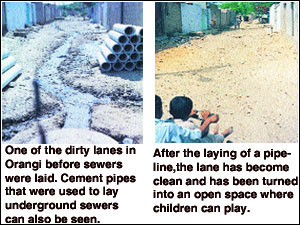 KARACHI, Oct 9: The Orangi Pilot Project (OPP) was launched in the early 1980s in Orangi, one of the biggest katchi abadis of the country, to help solve the dwellers’ problems relating to health, sanitation, education, low-cost housing, employment etc. Lacking in resources, education and organization, the residents of the sprawling colony were scarcely able to address any of these problems and concerns. The provincial government was not in a mood to help and the federal government was simply unconcerned.
The late Dr Akhtar Hameed Khan launched the OPP with theassistance of a charity foundation associated with the now defunct Bank of Credit and Commerce and International (BCCI). A social scientist who had earlier launched and managed the Comilla Project in the then East Pakistan, Mr Khan had come to the conclusion that if properly motivated and suitably organized, the ordinary people possessed an ample capacity to get things done.
Over a couple of decades down the line, the OPP has not only successfully solved these issues in a major area of Orangi, where a substantial improvement can be seen in the quality of life of the residents, but has been approached by various other non-governmental organizations, the government and even international donors for guidance. The OPP model is being replicated in various katchi abadis in Karachi, numerous towns in different parts of the country and even in some other developing countries.
In the meantime, the OPP has been divided into three separate organizations — the OPP Research and Training Institute; the OPP Orangi Charitable Trust; and the OPP Karachi Health and Social Development Association (KHASDA), which handle separate issues independently.
SANITATION: OPP identified low-cost sanitation as one of the major issues of the residents. It mobilized the residents and held meetings to inform them of the dangers that overflowing sewage posed to their health. The residents were told that they would save money that they had to constantly spend on the medicines while the capital needed to lay a sewerage system would be a one-time expenditure.
One basic principle that OPP observed from the very beginning was that it would itself never handle money from the residents. People would be asked to select a manager from amongthemselves at the lane level. OPP engineers and architects, etc, would only prepare the designs and layout maps and hand these over to the lane managers, who would implement the plan. If they required any assistance, they could always approach the OPP technical staff.
Perveen Rehman of the OPP says following this pattern, the people of Orangi have invested Rs86.28 million on building over 6,250 lane sewers, 417 secondary sewers and nearly 94,000 latrines in their homes. If the government had carried out this plan it would have probably cost Rs600 million.
OPP was able to lower the cost because of technical research, which had modified engineering standards and made them compatible with the economics and sociology of low-income groups based on the concept of community participation. OPP is now lobbying the government to lay down secondary and main sewers and treatment plants to complete the sewerage system.
For every one rupee that the OPP has invested in capital costs, research, extension and administration of the sanitation programme, the people of Orangi have invested Rs17. Thousands of lanes have become cleaner and have been converted into community open spaces which also serve as playgrounds.
Ms Rehman said OPP standards had been adopted by local government, NGOs and international donors like Department for International Development. The programme is being replicated in 160 settlements in Karachi through government agencies, NGOs and CBOs and in over 10 cities in different parts of the country. It is also being replicated in Central Asia, Nepal and certain settlements in South Africa. The model has been named as a component-sharing model.
The OPP activist said the model when applied to Karachi had reduced the cost of the Asian Development Bank-funded Greater Karachi Sewage Plan for Korangi sector to less than one-third of the original cost and community pressure on the Sindh governor had led to cancellation of a $100million-ADB loan.
HOUSING: Through a research study carried out on the basis of “sociology, technology and economics” the OPP came to the conclusion that local building component manufacturing yards — locally known as “thallas” — were crucial to the solution of the housing problem in Orangi those managing the yards acted as architects, contractors and credit suppliers for the low-income house builders.
OPP provided technical assistance to “thalla” operators so that they could modernize and mechanize their production, improve their products and also trained their staff. A cheaper roof material was also introduced to the “thalla” operators. Many masons and unemployed youth from Orangi have been provided training at the OPP institute and architectural advice is provided to the house builders on aspects of ventilation, light, and hygiene-related matters.
Nearly 60 thallas have been mechanized, nearly a 100 masons have been trained and many para-architects have been trained. Approximately 4,000 housing units per year benefit from the OPP’s technical research and extension.
EDUCATION: Evaluating the status of education in Orangi OPP found out that it would be expensive to open model schools and identified over 780 small private schools that were already operating in the area, and although not in a good condition, catered to a vast majority of the population.
OPP arranged financial assistance through the Orangi Charitable Trust and nearly 400 loans were provided to the schools. Academic improvements have been made by arranging teachers’ training through the existing organizations, provision of books for students and audio-visual aids for libraries and publication of manuals and guide books for teachers. Teachers’ training through the Allama Iqbal Open University is also being coordinated.
MICRO-CREDIT: OPP found out that the major part of the labour force was employed in the informal sector, which do not have easy access to the cheap government credit. The informal market carried an interest rate ranging between eight and 12 per cent per month. It estimated that there were nearly 23,000 small businesses employing nearly 120,000 people in Orangi.
OPP now extends credit to people already in business and also to people who want to establish new ventures provided that they have been employed in the trade they propose to follow. So far over 10,000 people have been extended loans and an amount of over Rs 200 million has been disbursed on which OPP charges around 18 per cent interest per year. Initially some loans could not be recovered, but now the system has been reviewed and more stringent precautions are taken in selecting the people before disbursement of the loans. The recovery rate has improved and is said to be more than 95 per cent.
Anwer Rashid, who heads the OPP’s micro-credit programme, says that the programme has been extended to the rural areas also and loans are being given to farmers and people dealing in agricultural products like dates, etc. The credit programme has been replicated by nearly 50 NGOs and CBOs operating outside Karachi. The successful experience of the micro-credit programme has led some of the commercial banks to initiate micro-credit programmes of their own with the First Women Bank taking the lead.
HEALTH: To solve health-related issues, OPP started sending its mobile medical teams to different Orangi localities to provide information to the residents regarding causes and prevention of common diseases. The teams arranged for immunization and also introduced family planning concepts and aids. But after some time it was found out that the programme was too expensive and could not be sustained.
OPP’s medical programme — Karachi Health and Social Development Association — chief Dr Shamim Zainuddin Khan says that a study was carried out that revealed that there were nearly 650 private clinics, besides many traditional birth attendants. The OPP has arranged for vaccines and family planning supplies to be provided to a large number of clinics. Nearly 475 Traditional Birth Attendants s and over 190 vaccinators have been trained.
An extension programme has been initiated with private clinics who are encouraged to employ TBAs and vaccinators. Many of the clinics were earlier unaware of government support programmes and these programmes also had only targeted CBOs and NGOs — many of which had no experience of health issues. Dr Shamim says a survey conducted by the OPP had showed a marked decrease in infant mortality and morbidity.





























