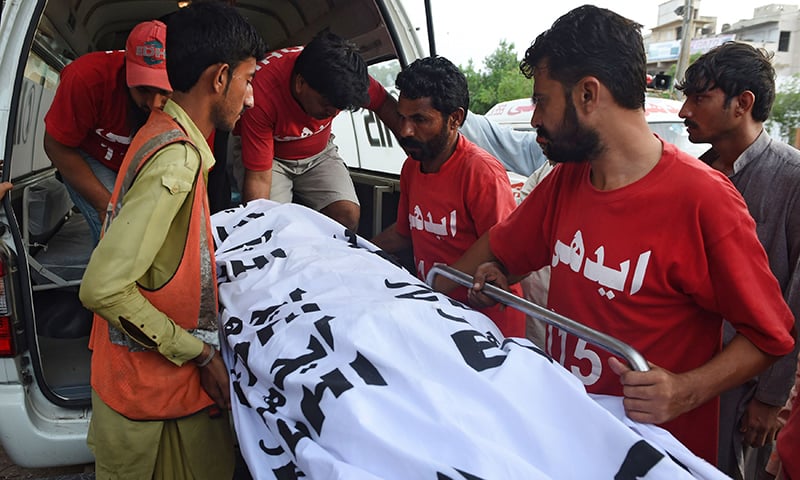

KARACHI: Death-row prisoner Shafqat Hussain was hanged to death at the Karachi Central Prison in the wee hours of Tuesday, after his hanging was postponed on four previous occasions this year, DawnNews reported.
Shafqat was arrested and sentenced to death in 2004 for the kidnapping and involuntary murder of a seven-year-old boy who lived in a Karachi apartment building where Shafqat worked as a security guard.
All courts in the land had turned down his appeals and the Supreme Court threw out a review petition that was the first to raise the matter of Shafqat’s juvenility at the time of arrest, maintaining that this line of defence should have been introduced at the trial court level.
Previously, Shafqat's legal team insisted that his earlier defence attorneys did not plead his case competently, which was why this aspect was overlooked.
The case also garnered a lot of attention on social and mainstream media and became a bone of contention between supporters and opponents of the death penalty. Rights groups including anti-death penalty campaigners Reprieve and Amnesty International had pleaded desperately with the government not to carry out the execution.
 |
| Brother of convicted murderer Shafqat Hussain, waits outside the prison to receive Hussain's body after his execution in Karachi on August 4, 2015. -AFP |
Almost six months ago, before Shafqat was scheduled to be executed on January 14, he was granted a last-minute reprieve and Interior Minister Chaudhry Nisar Ali Khan had ordered an inquiry to establish the veracity of the lawyers’ contention that Shafqat was a minor at the time of sentencing.
Explore: Shafqat's execution stayed for 30 days, jail authorities tell ATC.
He was then set to be executed on March 19 but a day before the sentencing, civil society representatives gathered in front of the Presidency against the order. The hanging was subsequently postponed for 72 hours and then for 30 days.
Death warrants for Shafqat Hussain were issued for the third time on April 24 after an executive inquiry by the Federal Investigation Agency (FIA) concluded he was 23 years of age when the punishment was handed down.
Take a look: FIA inquiry concludes Shafqat ‘wasn’t a minor’
According to the text of the report, seen by Dawn, a three-member FIA inquiry team, led by Deputy Director Gulfam Nasir Warraich, had found “absolutely no contradiction in the record (which includes his pictures at the time of arrest) that Shafqat Hussain was 23 years of age at the time of arrest”.
 |
| Shafqat Hussain was said to be 14 years old at the time of his conviction. - via Justice Project Pakistan |
But a day before his execution on May 6, the Islamabad High Court stayed his hanging until a verdict was issued on a petition filed by the Justice Project Pakistan (JPP), which called for a judicial inquiry into the age of the death-row convict.
Read: Shafqat Hussain's execution delayed for third time.
Eventually, the court dismissed JPP’s petition seeking his age verification to avail the benefit of Juvenile Justice System Ordinance.
An anti-terrorism court in Karachi on June 1 issued a fresh death warrant for Hussain, ordering his execution on June 9.
Superintendent Central Jail Karachi wrote a letter to the judge of ATC III, saying that the stay period of Shafqat's execution was over, and therefore a black warrant be issued for the hanging of the death-row prisoner.
ATC III judge issued a death warrant for the condemned prisoner with directives to hang him till death on June 9 at 4:30 am under the supervision of a judicial magistrate, and sought a compliance report after executing him.
 |
| Parents of convicted murderer Shafqat Hussain, react after Shafqat's execution in Karachi. -AFP |
But the convict's execution was once again delayed late on June 8, creating a mystery among authorities on who ordered the postponement.
Read: Mystery shrouds last-minute reprieve for Shafqat Hussain.
Sources in the Presidency later told Dawn the execution was apparently put off on the orders of the Sindh jail authorities.
Following an initial inquiry, they said, President Mamnoon Hussain had been informed about how the execution had been postponed and on whose instructions.
On July 27, after expiry of the moratorium on death penalty in the holy month of Ramazan, an ATC issued fresh black warrants for Shafqat with directives to hang him till death on August 4 at 4:00am under the supervision of a judicial magistrate.
Pakistan lifted the ban on executions in December 2014, which had been in place since 2008, following a Taliban attack on a school in Peshawar that killed more than 150 people – mostly children – in the country's deadliest ever terror attack.
The death penalty was initially reserved for terror convicts but was extended to all capital crimes in March.
Critics say Pakistan's criminal justice system is marred by police torture and poor legal representation, meaning many of those now facing execution have not had a fair trial.
The United Nations, the European Union, Amnesty International and Human Rights Watch have called on Pakistan to re-impose its moratorium on the death penalty.