ISLAMABAD: Pakistan wants its snow leopard back that was sent to the Bronx Zoo in New York eight years ago.
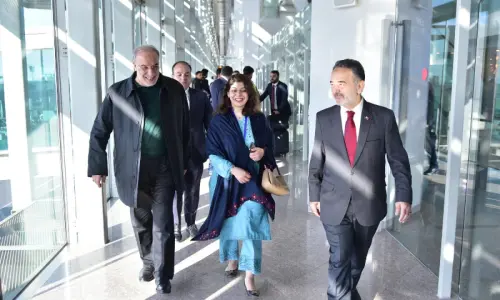
At a meeting on Sunday, Secretary Forest Gilgit-Baltistan Sajad Haider requested the Federal Minister for Climate Change Senator Mushahidullah Khan to push the US government to return the snow leopard.
He informed the minister that the orphaned snow leopard was recovered from a shepherd in Naltar valley of Gilgit-Baltistan in 2005.
The cub was temporarily shifted to the zoo in New York under a memorandum of understanding signed between the World Conservation Society and the Gilgit-Baltistan administration in 2006 for better care and inclusion in their snow leopard breeding programme.
“The snow leopard that was named Leo was a cub and handed over to the Bronx Zoo authorities because Pakistan lacked facilities for its proper nourishment, and until the time a set up was developed for the rehabilitation of such rare species,” the forest official told the minister.
He said under the MoU it was agreed that the cub would remain at the Bronx Zoo until an appropriate facility for captive snow leopards was established in Pakistan. Two such facilities have been built, one in Khyber Pakhtunkhwa and another in GB and both set-ups are home to two female snow leopards. Mr Haider explained how the GB forest and wildlife department was now ready to house Leo at an appropriate facility in Naltar.
Orphaned cub recovered from Gilgit-Baltistan was sent to US zoo under an agreement with World Conservation Society in 2006
The snow leopard at Bronx Zoo is now being considered important and is allowed to mix with captive population of snow leopards.
Leo has proved successful in the breeding programme to ensure survival of the endangered species. Leo was able to breed with the captive females and now has fathered a cub in the captive breeding programme.
Mr Haider said under the MoU the WCS had also agreed to return Leo to Pakistan possibly with a female after a few years as well as train the staff in Pakistan on how best to care for such exotic creatures.
Senator Khan also received a written request from the GB forest secretary asking his office to take up the matter with the US authorities concerned for returning the snow leopard.
The minister, who was elected chairman of the global snow leopard committee earlier this year, said he would play his part in retrieving the snow leopard.
Director Biodiversity, Ministry of Climate Change, Raja Naeem believed that it was about time Pakistan did something to ensure the survival of indigenous and endangered species.
“The facilities are available and under the agreement the snow leopard should be returned to Pakistan where it can have its own breeding programme,” said Mr Naeem.
Published in Dawn, June 1st, 2015
On a mobile phone? Get the Dawn Mobile App: Apple Store | Google Play