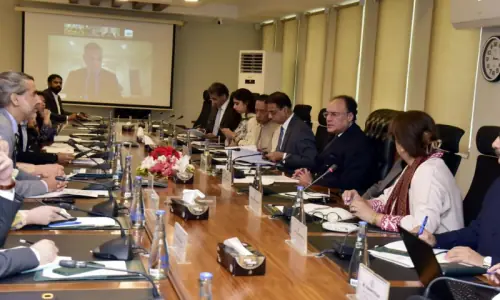
ISLAMABAD: Planning and Development Minister Ahsan Iqbal said on Thursday that Pakistan and China had agreed to “fill in the blanks” in the existing route between Gwadar and Kashgar under the CPEC project, adding that no new alignment had been considered over the past two years.
Talking to journalists, he said the leadership of the two countries had signed a memorandum of understanding on the China-Pakistan Economic Corridor (CPEC) on July 5, 2013 and constituted a joint working group to make decisions on connectivity of routes from Gwadar to Kashgar.
Take a look: Special committee to oversee CPEC project
In line with the Chinese wisdom, he said, Section 3 of the MoU required that a long-term plan should be developed under the principle of scientific planning and work on the easiest sections of the project should be given priority.
Minister insists no change has been made in original plan
Under this philosophy, the working group decided to expand the existing motorway through construction of its Multan-Sukkur section by the Chinese government and Karachi-Hyderabad section by the Pakistan government.
The minister disclosed three routes of the economic corridor. According to him, the western route originating from Gwadar will pass through Turbat, Panjgur, Nag, Basima, Sorab, Qalat, Quetta, Qilla Saifullah and Zhob and reach Dera Ismail Khan before leading to Islamabad. A couple of sections of the road between Gwadar and Quetta are currently at an advanced stage of construction.
The second (central) route will originate from Gwadar and reach Dera Ismail Khan via Basima, Khuzdar, Sukkur, Rajanpur, Layyah, Muzaffargarh and Bhakkar.
The third route will include Gwadar, Basima, Khuzdar, Sukkur, Rahimyar Khan, Bahawalpur, Multan and Lahore/Faisalabad and then reach Islamabad.
The minister said the road from Islamabad to Khunjerab had to be improved to the standard of Khunjerab-Kashgar road.
In reply to a question, he said the confusion over the location of industrial parks or economic zones along the economic corridor was politically motivated because no decision had been made on that yet. “So far only four joint working groups on energy, long-term planning, Gwadar port and transport and infrastructure have been formed and are working. The fifth group on industrial parks or economic zones is yet to be constituted.”
He said it was illogical to talk about the sites of industrial zones when the body to decide their location had not been formed.
He said all the parties and provinces had been asked to suggest sites for industrial zones that would be considered on scientific and economic grounds by the joint working group.
He said the rail project as part of the CPEC was a long-term project to be taken in hand after `early harvest’ projects were completed in two to three years, followed by medium-term projects to be completed in 2020.
He said Gwadar to Khunjerab rail link was included in the long-term projects which would be completed by 2030.
Published in Dawn, May 15th, 2015
On a mobile phone? Get the Dawn Mobile App: Apple Store | Google Play