0
0

 |
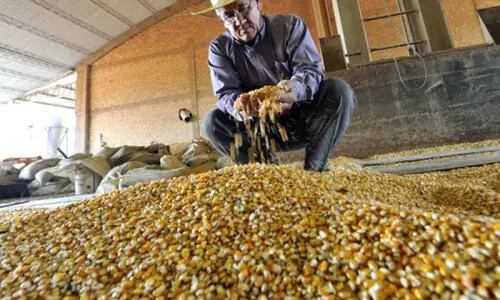
| HERAT: An Afghan shepherd talks as he combs cashmere from a goat in Herat city, west of the capital Kabul.—AP |
HERAT: Not so long ago, Afghan farmers collected the thick winter undercoat their goats shed every spring and threw it on the fire to heat their homes and cook their food.
Some have since learned that the super-soft fluff that comes off in clumps as the weather warms up, once cleaned, refined and spun into yarn is cashmere — a luxury product that finds customers as far away as the United States, Britain and Europe
It’s changed life for goat herders like Mohammad Amin. He has 120 goats grazing the open spaces around an industrial park on the outskirts of the western city of Herat. At this time of year, most of the female goats have kids and shed the cashmere, which Amin pulls off in huge handfuls.
With an extended family of 13, he has a guaranteed income from the best of the cashmere he harvests as traders, processors, donors and international businesses are cottoning on to Afghanistan’s potential as a major producer. “Buyers come to us and buy the good quality cashmere, the rest we take to the market and sell,” Amin said.
Each animal yields up to 250 grams (8.8 ounces) of cashmere, Amin said. Each season he can earn more than 61,250 afghanis ($1,100) — not bad in a country where the annual national average is less than $700.
Only about 30-40 per cent of Afghanistan’s 7 million goats are combed for cashmere, according to estimates by the World Bank and the US Agency for International Development, even though up to 95pc of the animals could become part of the production chain. Most of the raw product is bought by traders who sell it to Chinese middlemen to feed the mills that produce affordable clothing for much of the world.
Afghanistan is the world’s third biggest producer of cashmere, its 1,000 metric tons (1,100 US tons) a year, worth $30m, accounting for 7pc of the global market, — though it lags far behind China’s 70pc and Mongolia’s 15pc. The government, recognising potential, recently came up with a “cashmere action plan,” aiming to target the highest end of the global luxury market — where a designer-label cashmere sweater can cost $1,000.
But it’s a long haul. Afghanistan remains a country in conflict after almost 40 years of war and few foreign investors are prepared to face such an insecure and uncertain environment, even if it’s to exploit world-class oil and mineral resources, or agricultural products such as pomegranates, saffron and cashmere.
Until recently, Afghanistan’s lack of processing capacity forced its cashmere goat herders to depend on the less discerning Chinese market. Unwashed cashmere can carry serious health risks, including anthrax spores, which has kept the Afghan product out of America and Europe.
It took years after the 2001 US invasion, which ousted the Taliban, for foreign businesses to start arriving — investors willing to bring money and expertise to develop a profitable, niche market. Long-term, it could be a self-sustaining industry in Afghanistan, one that will create jobs — including work for women, generally marginalised in this society — from farm to factory, and eventually beyond, to fashion.
Brian Ross, fund manager with the Afghanistan Business Innovation Fund, financed by the British government’s Department for International Development, is optimistic. He is working with the British company Cashmere Fibres International in a joint venture with Belgian investor Traitex.
Together, they have a cashmere processing plant in Herat, one of only two in Afghanistan creating a product of European standard.
“On the lower end of the value chain, there is a lot of cashmere” which, once processed, “can be sold to the high-end luxury textile manufacturers,” he said. “So absolutely, there is a strong potential for growth in the Afghan sector.”
Cashmere is not a wool but a hair, which accounts for its unique characteristics compared to sheep’s wool — soft and fine in texture, light and strong at the same time. In the near-sterile conditions at Herat’s CFI-Traitex plant, the filthy, matted raw goat coat is washed and the long hair is separated from the cashmere.
The cashmere is repeatedly refined, becoming increasingly gossamer-like as it is transformed into the highest quality, pristine, aerated fluff. It is then baled and sent to Europe, ready to be spun into the finest yarn that can be dyed and knitted or woven into fabric, carpets and clothing.
No matter how much export-quality cashmere the plant turns out, it is guaranteed to be sold, said Sayed Ahmad Jami, project manager.
The Afghan Ministry of Commerce and Industry says the global market value for cashmere is over $1bn. As China is known to blend different qualities of cashmere to achieve volume, the ministry believes the top end of the market is wide open for the unadulterated Afghan product.
To that end, a small spinning operation in Kabul called Qaria — meaning “village” in Dari — has just taken Afghanistan a step higher on the ladder to high fashion with a successful three-month pilot programme spinning the Herat cashmere into yarn and dying it using plant-based colorants sourced locally.
Briton James Blewett, a partner in Qaria, says they have orders for the yarn from America, Britain and Europe, where it is gaining popularity in knitting shops. Qaria yarn sold out within hours at a recent wool trade fair in Britain, he said.
Blewett said the company’s first hand-knitted garments could be on sale later this year, carrying with them hopes of cashmere excellence — a label bearing a stylised goat’s head, with the words “Afghan Made.”
Published in Dawn, May 10th, 2015
On a mobile phone? Get the Dawn Mobile App: Apple Store | Google Play